Your weekly poem: Phoenix—or rising from the ashes

Your weekly poem: Phoenix—or rising from the ashes

🌿 A poem a day keeps the blues away
 

PHOENIX–or rising from the ashes. 🌿

đŸŒ» Are you willing to be sponged out, erased, cancelled,
made nothing?
Are you willing to be made nothing?
dipped into oblivion?

If not, you will never really change.

The phoenix renews her youth
only when she is burnt, burnt alive, burnt down
to hot and flocculent ash.
Then the small stirring of a new small bub in the nest
with strands of down like floating ash
shows that she is renewing her youth like the eagle,
immortal bird. đŸŒ»

–D.H. Lawrence (1885-1930)
Published posthumously in the 1932 collection “Last Poems”

Image of a Phoenix by Pixabay

I sometimes offer my clients an image

đŸȘŽ I sometimes offer my clients an image or metaphor that captures how I experience them or what we’ve been exploring together. In a recent session, I offered one client the image of a phoenix rising from the ashes.

For this week’s poem, I wanted to find words that honour both the beauty and the pain of such a rising.

Much change mean becoming “nothing”?

I admit that I find Lawrence’s poem uncomfortable to read. He certainly does not mince his words with his opening line:

đŸŒ± Are you willing to be sponged out, erased, cancelled,
made nothing?

And he doesn’t stop there. He keeps going, rubbing salt in an already open wound:

đŸŒ± Are you willing to be made nothing?
dipped into oblivion?

Then comes his uncompromising verdict:

đŸŒ± If not, you will never really change.

I honestly don’t know if I can fully agree—his words feel so harsh, so unforgiving. Must the only way to change be through oblivion? Becoming “nothing”?

Reading Lawrence in the shadow of mortality

đŸȘŽ When I place Lawrence’s words in the context in which he wrote them, at the very end of his life while dying from tuberculosis, I can begin to understand their intensity.

Maybe Lawrence was trying to make sense of his own physical decay and mortality, reaffirming that this is not the end. That, just like a phoenix (one of his lifelong personal emblems), he will rise and live once more, as an immortal soul.

He’s not just talking about a regular change, like eating more healthily or going to the gym more often. He is talking about complete transformation.

đŸȘŽ I can think of a couple of people I know who radically transformed after an incredibly painful experience lasting years. Just like the Phoenix (or the chrysalis image I offered two weeks ago), Lawrence is asking us to allow the pain and the suffering in our own lives, so that we can truly transform—whereby one living form needs to die so it can become something completely new.

When life thrusts transformation upon us

đŸȘŽ I still find his opening words incredibly uncomfortable, and I am not sure I feel ready for such an “obliteration”. And maybe that’s why, usually, when such transformations take place, it’s not because we sought them but because life thrusts them upon us somehow, leaving us only the choice of response


And I keep returning to what happens later in the poem:

đŸŒ± Then the small stirring of a new small bub in the nest

đŸȘŽ After all the suffering and burning, there’s a small beginning.
No grand entrance. Just a stirring.

The stirring of what will one day soar like an eagle—an immortal bird.

The small stirring of a new beginning

So, if you find yourself in such a space right now—crushed, lost, questioning your worth, unsure of who you are or who you are becoming—know that you are not only worthy, you are beautiful, and unique, and loved—just as you are.

☀ And one day, you too, will rise as a phoenix out of the ashes. ☀

Hope is not  a fantasy

📌 Hope is not a fantasy. It is a strategy that allows us to notice the stirring in the nest.

🩋 Happy Weekend everyone! 🩋

With love,
Dina đŸ«¶đŸœ

Resources:

  • This week’s song đŸŽ¶ is BLACKBIRD by The Beatles. 
Beyond STAR: How to structure examples in an interview

Beyond STAR: How to structure examples in an interview

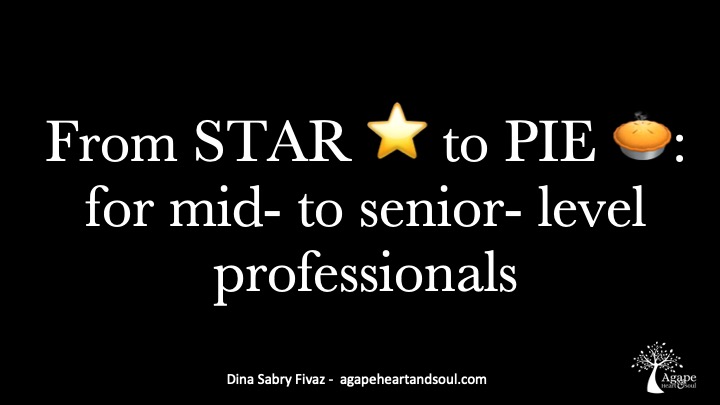
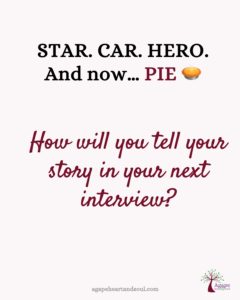
STAR ⭐, CAR 🚗, HERO đŸŠžđŸœâ€â™€ïž, and my own approach, PIE đŸ„§â€”four ways to tell your story, and why I prefer bringing impact forward for more senior roles.

There’s no shortage of acronyms when it comes to ways to prepare for an interview:

STAR – CAR – HERO – and I’ve decided to throw my hat in the ring as well with đŸ„§ PIE đŸ„§!

Let’s take them one by one.

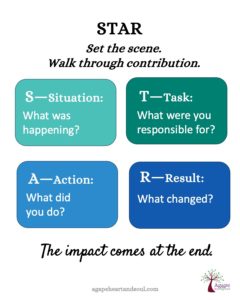
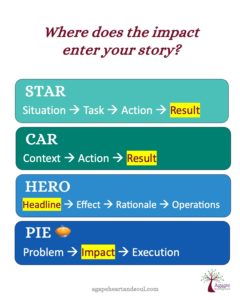
⭐ STAR stands for ⭐:

đŸŒ± Situation: what was happening?
đŸŒ± Task: what were you responsible for?
đŸŒ± Action: what did you do?
đŸŒ± Result: what was the outcome of your actions? What did you learn?

STAR: Situation. task. Action. Result.

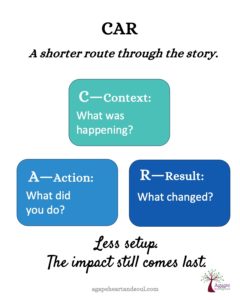
🚗 CAR stands for 🚗:

đŸŒ± Context or Challenge: what was the specific situation or problem?
đŸŒ± Action: what did you do?
đŸŒ± Result: what was the outcome or impact?

CAR: Challenge or Context. Action. Result.

Both are useful ways to structure your answer.

The challenge? Getting so caught up in the background that five minutes later, you’re still setting the scene
 So, when using STAR or CAR, the key is to keep it short. Your interviewer can always ask for more detail if they need it.

Over time, however, I’ve found that STAR and CAR are most suitable for professionals early in their careers.

Why I prefer a different approach for senior roles

📌 For mid- to senior-level professionals, they don’t quite cut it in my view. For these kinds of roles, I would recommend exploring HERO, which I came across through Farah Sharghi, or my own approach, PIE đŸ„§.

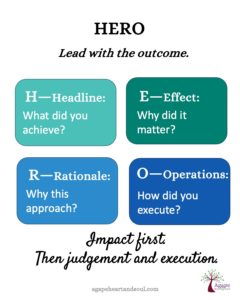
đŸŠžđŸœâ€â™€ïž HERO stands for đŸŠžđŸœâ€â™€ïž:

đŸŒ± Headline: What was the outcome? One sentence that grabs the interviewer’s attention.
đŸŒ± Effect: Why did it matter? What problem did you solve?
đŸŒ± Rationale: What options did you consider, why did you make your decision?
đŸŒ± Operations: What did you or your team actually do—method, tools, execution.

HERO: Headline. Effect. Rationale. Operations.

đŸ„§ PIE: my own approach đŸ„§

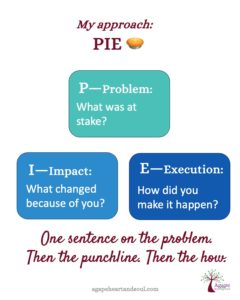
📌 I came up with PIE đŸ„§ because I find it easier to remember, and I like its story arc:
establish what was at stake, reveal what changed, then explain how

☀ Problem: What problem were you addressing? You want your listener to understand what was at stake and get them invested in your story.

☀ Impact: Give them the punchline. What impact did you achieve? What changed because of your contribution? Now they know what changed—and they’re ready to hear how you did it.

☀ Execution: How did you make that happen? This is where you explain your decisions, the trade-offs, and how you brought people with you.

PIE - Problem, Impact, Execution

HERO or PIE: where does your story begin?

HERO leads with the outcome.

With PIE, you give the problem one sentence first–just enough to make the impact meaningful. Then you explain how you got there.

At senior level, the impact you made, the judgement behind your decisions, and how you brought others with you is what matters most. That’s why HERO or PIE appeal more to me.

STAR - CAR - HERO - PIE - 4 interview answering techniques

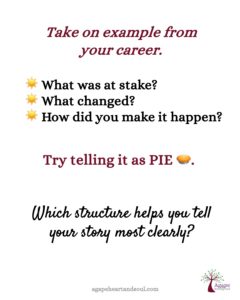
Try it with an example from your career

📌  Take one example from your career. Which structure helps you tell it most clearly?

PIE - try it out.

Let me know in the comments đŸ‘‡đŸœ.

With love,
Dina đŸ«¶đŸœ

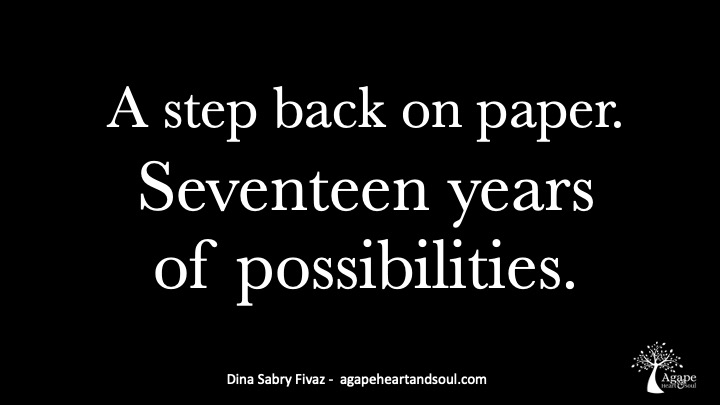
A step back on paper. Seventeen years of possibilities.

A step back on paper. Seventeen years of possibilities.

Over the past few weeks, I’ve shared how one humanitarian course with the Irish Defebce Forces, six months in Serbia, and a year and a half at the UN made me realise HR was my home—just not Compensation & Benefits.

The answer came through a role I was, on paper, overqualified for.

A smaller title. A wider field to explore.

đŸŒ± While at the UN in Geneva, I spotted an HR Analyst vacancy at Roche in Basel. 

I can still picture myself sitting in m tiny Geneva studio, looking at the vacancy and wondering whether I should really “give up” the UN dream and go back to the corporate world.

From Head of C&B for Eurasia to HR Analyst? A considerable pay cut and, to many, a step backwards.

But the role offered something I wanted: experience across HR in a global function—recruitment, talent management, business partnering, succession planning, and more.

So I applied.
A bunch of interviews & a case study followed.

“She’s overqualified. She won’t stay.”

I later learned that my future manager, his manager, and a team member (who became a friend) advocated for hiring me.

The HR manager was against it: I was overqualified; I’d be taking a considerable pay cut; I’m unlikely to stay.

Understandable concerns. But I had already put them on the table in my interviews with the leadership.

They would get an experienced professional to help with operational projects. I would broaden my HR experience. I committed to two years, hoping to then grow into a larger role within Roche.

My ambition hadn’t disappeared. This was my stepping stone, and I was transparent about it. No hidden agendas. No games.

I got the job.

đŸŒ± Less than a year later, a new Global Head of HR arrived, and my position was eliminated. So much for the two-year plan. 😉

I was offered the chance to manage an HR IT rollout project for local HR.

“What a patchwork CV.”

The hiring manager said: “What a patchwork CV!”

I initially smiled—until I realised that, in her world, patchwork meant messy. No red thread. A gentle nudge to focus my career towards a clear goal.

đŸŒ± Only, in my world, patchwork is an asset. More importantly, it’s who I am: an insatiable mind with a rainbow of interests. Why should I settle for one single upward career path?

She hired me anyway.

That project opened up another 16 years at Roche, spanning local and global HR roles, including heading Diversity & Inclusion for Basel/Kaiseraugst.

My patchwork has never let me down. It’s helped me deliver in ambiguous roles I had to shape and navigate re-orgs.

And today, it helps me run an executive and career coaching practice, helping clients clarify their aspirations, experiment with possible “future selves”, stay motivated in what is bound to be a bumpy ride, and find the courage to take their next steps and have the conversations they need to have.

It makes me a better coach.

☀ What’s the point of this story? ☀

Text graphic: a step back on paper. Seventeen years of possibilities.

When I left Novartis, I followed an intuition. I didn’t have a complete picture of where it would lead.

I experimented. I learned what suited me and what didn’t. Eventually, I found my way back to HR—and into parts of it I hadn’t experienced before.

Along the way, I’ve made, what to some may seem difficult to understand or insane to others. But to me, they made total sense: sometimes we need to step back to step forward.

Career paths don’t have to be one-way streets. Sometimes we change direction, reverse, do U-turns, or pull over to rethink our route. 😊

I couldn’t have mapped out those seventeen years at Roche. I saw an opportunity to learn, contribute, and explore. That was enough to take the next step.

Sometimes, a smaller title opens up a much wider field.

📌 Have you ever made a career move that raised a few eyebrows—but made perfect sense to you?

📌 What might your next career move make possible—beyond the title on your CV?

With love,
Dina đŸ«¶đŸœ

Previous posts in this career-exploration series:

    CV tip: Is your CV up to date, but still wishy washy?

    CV tip: Is your CV up to date, but still wishy washy?

    Your CV is up to date but is it still wishy-washy

    When I help clients rewrite their CV—or that crucial first page—I often start by interviewing them, because what’s on the surface is rarely the whole story…

    “Is this your most up-to-date CV?”
    Yes.

    “And it includes your key responsibilities and achievements?”
    Absolutely!

    Then I start reading…

    Supported cross-functional collaboration to drive strategic Pharma initiatives.

    A bullet point trying to encompass everything by saying absolutely nothing.

    “What does that actually mean?”

    So, I start digging…
    đŸŒ± What was the initiative?
    đŸŒ± Who were you collaborating with?
    đŸŒ± What was your role?
    đŸŒ± What changed because of your work?

    Imagine someone in Pharma whose “cross-functional collaboration” turns out to mean coordinating medical, regulatory, and commercial colleagues across four continents to close launch-readiness gaps for a rare disease diagnostic tool—helping the teams meet their designated launch dates in the US, EU, and China.

    Now we have something to work with.
    A specific piece of work. A scope. A meaningful impact.

    Give up the Corporate Jargon. Sound Human.

    And yes, companies can be guilty of this “sin” too: job ads so full of corporate jargon that you still have no clue what the heck the job is about.

    But I beg you—you don’t have to carry that language into your CV as well.

    Give up the corporate jargon and sound (somewhat) human 😄.

    Interview yourself: Purpose, Scope, Contribution, outcomes

    📌 You can interview yourself, too.

    Read each bullet on your CV as though it belongs to someone else.
    What would you ask to understand what they actually did?

    Look for:
    ☀ Purpose: what problem or unmet need were they addressing?
    ☀ Scope: which products, markets, therapeutic areas, teams, or budgets? At what scale?
    ☀ Contribution: what did they personally do?
    ☀ Outcomes: what changed, improved, or became possible?

    Use measurable results 📐 where you have them.
    Where you don’t, describe an observable 👀 outcome. Don’t invent a percentage just because you think every bullet needs one.

    You’re not trying to sound impressive. You’re trying to be factual, specific, and less wishy-washy. Why?

    📌 Because how else can you expect to stand out in a flooded market if you sound like everybody else?

    Keep asking “What else?”

    Give yourself that interview. You might even surprise yourself with what you’ve actually accomplished.

    Oh, and don’t stop at the first few bullet points. Keep asking
    📌 “What else?”

    I bet there are one or two forgotten gems to be uncovered… You can then choose the most relevant ones to highlight.

    And if you’d like someone to do the digging with you, that’s part of my work. I bring HR experience, questions, and curiosity to help you uncover—and communicate—the value of what you’ve done.

    Because, let’s face it—sometimes, it needs a fresh pair of eyes to spot the treasures where the dust has settled…

    With love,

    Dina đŸ«¶đŸœ

    Previous related post in this CV-writing series:

      Resources:

      • A little antidote to Corporate jargon:
        Watch my dear friend Peter Sandbach’s brilliant 2016 TED talk, “A cure to Corporate jargon”. It should cure yours too. 🙂

      Your weekly poem: I dwell in Possibility

      Your weekly poem: I dwell in Possibility

      🌿 A poem a day keeps the blues away
 

      I DWELL IN POSSIBILITY—and the space we give it in our lives. 🌿

      đŸŒ» I dwell in Possibility
      A fairer House than Prose,
      More numerous of Windows,
      Superior of Doors.

      Of chambers, as the Cedars —
      Impregnable of eye;
      And for an everlasting Roof
      The gables of the sky.

      Of Visitors — the fairest —
      For occupation — this —
      The spreading wide my narrow hands
      To gather Paradise. đŸŒ»

      —Emily Dickinson (1830 – 1886)

      Windows, doors, and a roof made of sky

      đŸȘŽ What I love about this poem is the space it gives to imagination.

      Windows đŸȘŸ through which we might see differently, try another perspective, become more aware. And with greater awareness comes greater choice.

      Doors đŸšȘ opening onto something we haven’t yet explored—a promise of adventure.

      A roof made of sky 🌅—limitless, connecting us with something larger than ourselves: nature, the spiritual, the divine.

      Dickinson is writing about poetry, imagining it as a house more spacious than prose.

      Life’s twists and Poetry’s bends. 

      đŸŒ± You see, prose is ordinary. Straightforward. Direct.
      It’s our usual way of writing or speaking, with standard grammatical structures, regular sentences and paragraphs.
      And there is great value in the ordinary, straightforward, and direct.

      But life is rarely ordinary, straightforward, and direct.

      It takes unexpected turns.
      It twists.
      It bends.
      It holds surprises in corners.

      đŸŒ± Just like poetry.

      Poetry is playful.
      It flirts with rhythm, beats, metres, and rhyme.
      It is bendable—phrases cut
      in half, sentences
      broken mid-way,
      words
      placed
      individually
      on
      a
      page.

      This can be destabilising, but it also opens up a space of freedom, imagination, creativity—a space of Possibility.

      Places to explore, places to linger

      Perhaps that is why I turn to poems myself:
      đŸȘŽ They give me room to linger with a question, without having to answer it straight away.

      I imagine the “fairest” visitors as us, the readers, bringing imagination, sensitivity, and patience into the poem.

      Poems are not puzzles to solve.
      They are places to explore,
      to linger in,
      sitting idly with a word, an image, an unusual phrasing.

      đŸȘŽ Often times I see clients trying to force life into a set of “prose”—when, in fact, life is more like a “poem”, requiring space for imagination and exploration.

      A little room for what we cannot yet see

      Earlier this week, I shared how exploring another career helped me find my way back to HR. I returned with new experiences, relationships and a clearer understanding of what mattered to me.

      đŸȘŽ Not every possibility needs to become a plan. Some help us see our present life differently. Others invite us to open a door.

      For me, this poem is an invitation to stay curious—and to leave room for what I cannot yet see.

      📌 Perhaps there’s a question in your own life that you keep coming back to.
      If so, you don’t have to know where it will lead to give it a little space.

      🩋 Happy Weekend everyone! 🩋

      With love,
      Dina đŸ«¶đŸœ

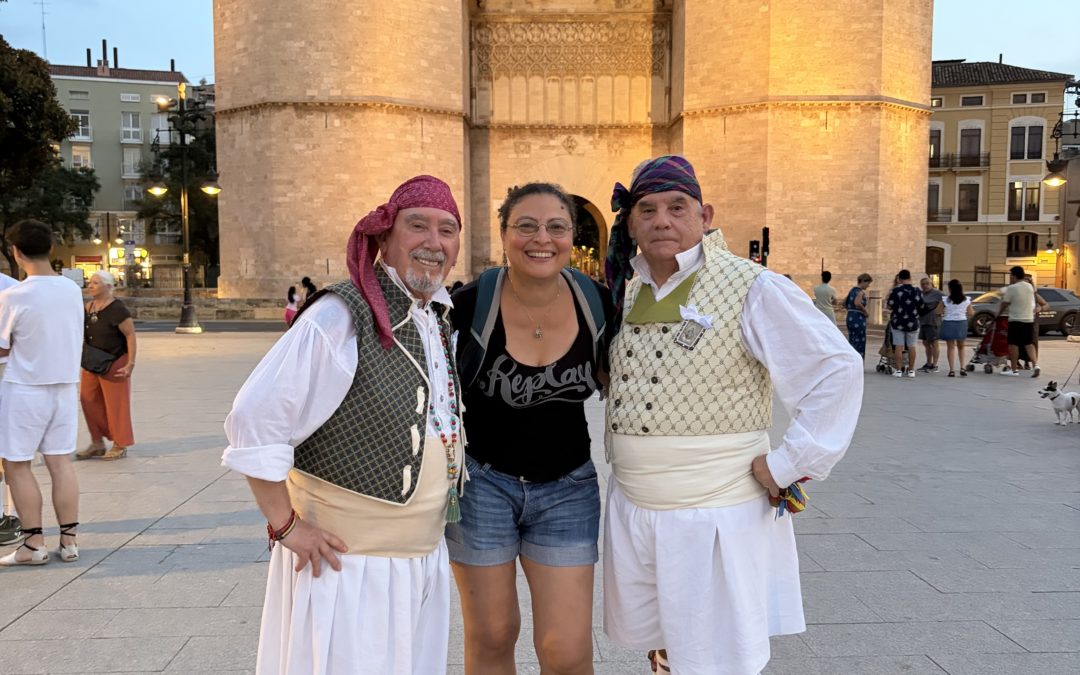
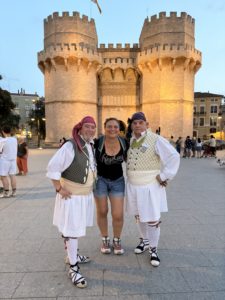
      Image of Dina Sabry Fivaz in Valencia, on an impromptu walk to Torres de Serranos
      Image of me in Valencia, on an impromptu walk to Torres de Serranos

            Resources:

            • Read Emily Dickinson’s full poem at: https://poets.org/poem/i-dwell-possibility-30
              Source: Academy of American Poets
            • This week’s song đŸŽ¶ is INTO THE MYSTIC by Van Morrison. A little music to accompany the wandering.

            How career experiments helped me find my way back to HR

            How career experiments helped me find my way back to HR

            Exploring a career beyond Human Resources

            It took me two years away from Human Resources (HR) to realise it was still my home.

            I don’t regret those two years. Without them, I would always have wondered: “What if?”

            Last week, I shared how a humanitarian training helped me realise that area wasn’t for me.

            But I had another dream still to explore: Human Rights.

            So, I ran another experiment. Then another.

            đŸŒ± Newsletters and online forums. Loved it.
            đŸŒ± A summer diploma in Economic, Social and Cultural Rights, including attending the UN Commission on Human Rights in Geneva. Amazing.
            đŸŒ± Six months in Serbia, leading an HR project while participating in the organisation’s Human Rights initiatives. A once-in-a-lifetime experience.

            ☀ Each experiment helped me take the next step. ☀

            My husband wasn’t keen on a life of moving between field missions, so I focused on Geneva-based jobs.

            An unexpected opportunity at the UN

            I applied for an internship at the Office of the High Commissioner for Human Rights.
            Everyone I knew said I wouldn’t get in without connections.
            I got two calls.

            The first came while I was on holiday. By the time I heard the voicemail on Saturday, the Friday deadline had passed. I called on Monday. They’d offered it to someone else.

            I was gutted. Convinced I’d blown it.

            Then, a few days later, another unit called: the NGO Liaison Office.
            I said yes immediately.

            đŸŒ± Had I answered the first call, I would have ended up in a “back-office” role. Instead, I found myself right in the middle of the action.

            ☀ Sometimes, God or the universe, whatever your belief, helps us a little. We just don’t recognise it right away. ☀

            An unpaid internship became a paid consultancy—and a year and a half that taught me so much.

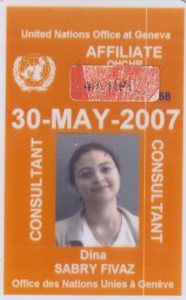
            picture of Dina Sabry Fivaz's UN badge as an OHCHR consultant

            I helped facilitate NGOs’ participation in the newly established Human Rights Council so their voices could be heard.

            I met inspiring rapporteurs and activists, including people risking their lives to speak out.

            I loved the cause, the work, and the people.

            But by the end, I also knew:
            đŸŒ± I needed more stability than temporary contracts offered.
            đŸŒ± The political sensitivities—and the constant care over what I said, how and to whom—took more energy than I wanted to give them.
            đŸŒ± Staying in Switzerland, I could see a way to make the more direct, immediate contribution I was looking for through HR.

            Human Resources was still my home. I just needed a different area within it.

            📌 You can’t think yourself through a career transition.

            Those two years gave me clarity, unforgettable experiences, and relationships I still cherish today.
            The experiments let me test the “what if” and choose my next step with a clearer understanding of what mattered to me.

            What happened next is for next week. 😊

            ☀ If you’re in pharma trying to figure out your next career step, I’ve been there myself. Today, I help people explore that question—not by rushing towards an answer, but by finding ways to test what might fit. ☀

            Explore career coaching for Pharma professionals. 

            With love,
            Dina đŸ«¶đŸœ

            More posts in this career-exploration series: