Your weekly poem: ON CHILDREN & PARENTING

Your weekly poem: ON CHILDREN & PARENTING

🌿 A poem a day keeps the blues away… 

ON CHILDREN & PARENTING

🌻 Your children are not your children.
They are the sons and daughters of Life’s longing for itself.
They come through you but not from you,
And though they are with you yet they belong not to you.

You may give them your love but not your thoughts,
For they have their own thoughts.
You may house their bodies but not their souls,
For their souls dwell in the house of tomorrow, which you cannot visit, not even in your dreams.
You may strive to be like them, but seek not to make them like you.
For life goes not backward nor tarries with yesterday.
You are the bows from which your children as living arrows are sent forth.
The archer sees the mark upon the path of the infinite, and He bends you with His might that His arrows may go swift and far.
Let your bending in the archer’s hand be for gladness;
For even as He loves the arrow that flies, so He loves also the bow that is stable. 🌻

— Kahlil Gibran (1883-1931), from The Prophet

🪴 Last Sunday was Mother’s day. In my household, it tends to be a day like any other, which I don’t mind. In fact, the two people who wished me Happy Mother’s Day “proactively” were my friends Andy, Maryam, & my mum’s dentist, who had kindly offered to do a check-up on his day off after her operation…

🪴 As I was reflecting on parenthood, I found myself drawn back to Gibran’s words—a wise reminder of what it means to be entrusted with a life.

I love being a mum to my wonderful 16-year-old. It’s the most important and precious role I’ll ever get to play, and I’m immensely grateful for it—all the more so because I’m well aware that there are countless people who would love to be a parent but can’t. I was almost one of them… until I wasn’t.

🪴 Reflecting on what it means to be a parent also reminded me of all the important parental figures I had growing up. People I knew I could rely on, and who were always there for me, especially when my parents couldn’t. Sometimes without a family of their own, they became my parent and I their child all the same—not by blood, but by extension, by choice, through love. These wonderful souls also deserve to be celebrated!

🪴 I also believe in celebrating our children—every day! For the person they are the moment they’re born. For the person they become as they grow, learn, and explore. For every step they take, every fall they make, and as they stand up again.

I celebrate my daughter for the fresh perspective she brings—those youth-tainted glasses she wears that remind me of a time that was and of all that can be. The joy and pain of every first. The discovery of life’s promises. The carving of her own path into the world.

It’s an enormous privilege to witness a child’s journey—whether they are our own or not.

🎉 Today, I celebrate you and all your loved ones! 🎉 

🦋 Happy parent day ! Happy children day ! Happy Friday everyone! 🦋

With love,

Dina 🫶🏽

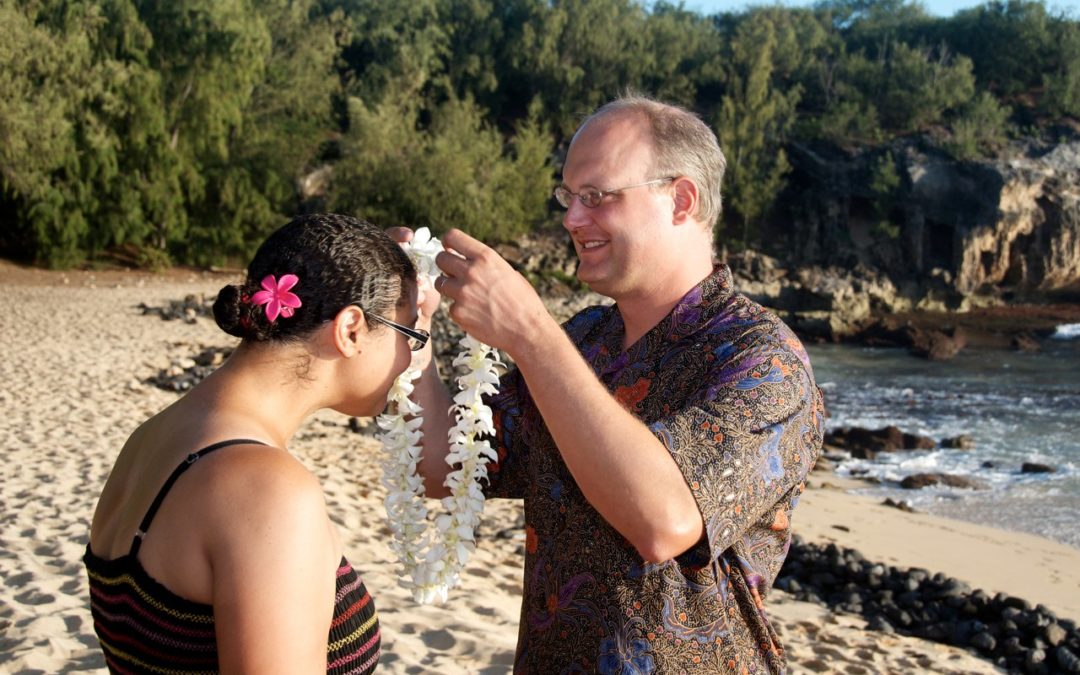
Image: My husband and I in Hawaii, 2012, renewing our vows a year and a half after our daughter was born.

Resources:

  • In celebratuion of YOU and all your loved ones, this week’s song is CELEBRATION by Kool & The Gang

Your weekly poem: WHY I WAKE EARLY

Your weekly poem: WHY I WAKE EARLY

🌿 A poem a day keeps the blues away… 

WHY I WAKE EARLY

🌻 Hello, sun in my face.
Hello, you who make the morning
and spread it over the fields
and into the faces of the tulips
and the nodding morning glories,
and into the windows of, even, the
miserable and crotchety–

best preacher that ever was,
dear star, that just happens
to be where you are in the universe
to keep us from ever-darkness,
to ease us with warm touching,
to hold us in the great hands of light–
good morning, good morning, good morning.

Watch, now, how I start the day
in happiness, in kindness. 🌻

— Mary Oliver
(published in “Devotions: The Selected Poems of Mary Oliver”)

🪴 I haven’t posted a poem for a few weeks now. Life has been life, I guess, with its usual ebbs and flows. As I finally sat down to share with you a poem, I picked Mary Oliver’s book and it opened on page 171, revealing WHY I WAKE EARLY.

🪴 I think any analysis of Oliver’s words would defeat the whole purpose of this simple but powerful poem. It’s not just an ode to the sun, but an ode to our planet and the beauty that surrounds us. And it’s meant to be experienced rather than analysed.

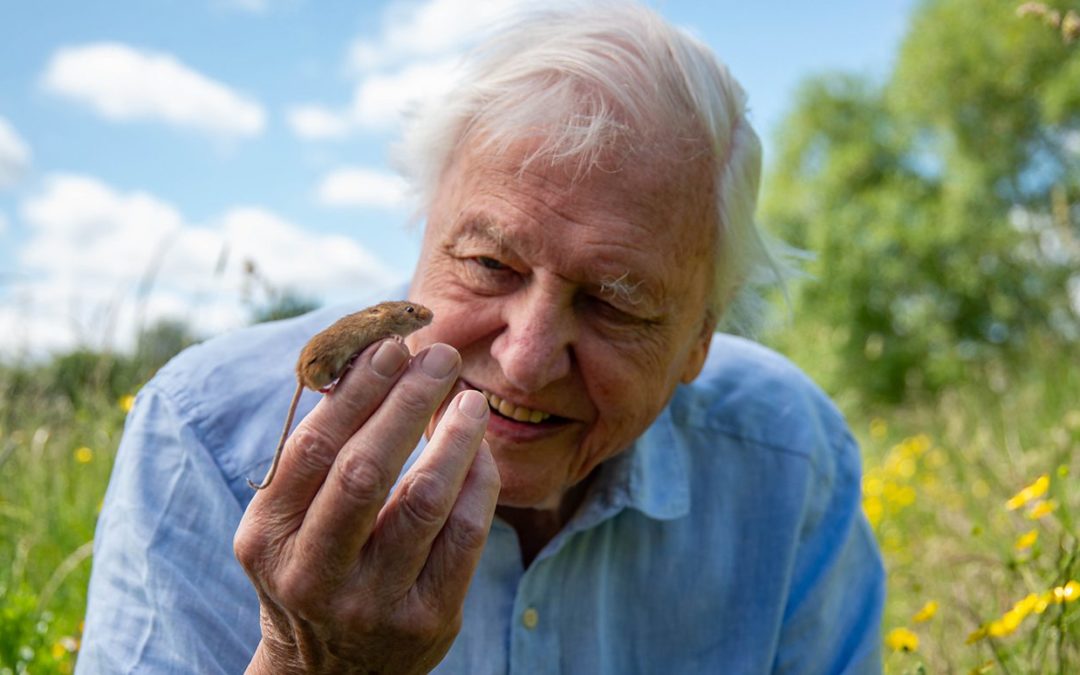
🎂 I find it interesting that this is the poem that revealed itself to me today (Friday 08 May), the same day we celebrate Sir David Attenborough’s 100th birthday: someone who has dedicated his life to sharing the wonders of our beautiful planet with millions of viewers in a most iconic way. 

📌 So, instead of a question, I invite you to wake up early tomorrow and experience the wonder that is “morning” through all your senses.

🎂 Happy 100th Birthday Sir David Attenborough 🎂

🦋 Happy Friday everyone! 🦋

🌹 And Happy Mother’s day (on Sunday)! 🌹

With love,

Dina 🫶🏽

Resources:

  • This week’s song is What A Wonderful World, cover by Sir David Attenborough—an ode to our planet

Your weekly poem: ALONE—or no man’s an island?

Your weekly poem: ALONE—or no man’s an island?

🌿 A poem a day keeps the blues away… 

On this blessed Good Friday, Maya Angelou’s poem ALONE came to mind.

ALONE

🌻 Alone
Lying, thinking
Last night
How to find my soul a home
Where water is not thirsty
And bread loaf is not stone
I came up with one thing
And I don’t believe I’m wrong
That nobody,
But nobody
Can make it out here alone.

Alone, all alone
Nobody, but nobody
Can make it out here alone.

There are some millionaires
With money they can’t use
Their wives run round like banshees
Their children sing the blues
They’ve got expensive doctors
To cure their hearts of stone.
But nobody
No, nobody
Can make it out here alone.

Alone, all alone
Nobody, but nobody
Can make it out here alone.

Now if you listen closely
I’ll tell you what I know
Storm clouds are gathering
The wind is gonna blow
The race of man is suffering
And I can hear the moan,
‘Cause nobody,
But nobody
Can make it out here alone.

Alone, all alone
Nobody, but nobody
Can make it out here alone.🌻

—Maya Angelou


Creative, resourceful, and whole

🪴 There’s a persistent belief in coaching—not sure where it originated—that clients are creative, resourceful, and whole.

I always struggled with that mantra, but it took me some time to figure out why.

It sounds amazing, and it’s one of those mantras we sure as heck want to be true. But the question is, is it?

Creativity and resourcefulness sit on a continuum—some have it more than others. But I do believe that we all carry a seed of both. How that seed develops, and how it shows up in action, will greatly vary…

Wholeness, on the other hand, is rooted in this modern-day thinking that we can be anything we want to be, and do anything we want to do, all on our own, if we only put our mind to it. Bollocks. No man is an island. And no talents are infinite.

Relational coaching practices try to tone this idea down by acknowledging the importance of the coach-client relationship, and the coach’s use-of-self as an instrument of change. And yet, we still hold on to the idea of “wholeness” as an individual trait, rather than a communal one.

Why are we so afraid to admit that each one of us has limits?
That no one can be everything to everyone.
That my talents have limits.
My creativity has limits.
My resourcefulness has limits.
My knowledge has limits.
My resilience has limits.

And once we accept that—that we, human beings, have limits—we start to understand that we can only become WHOLE with one another.

“No human being is ‘whole’ in and of itself”

🪴 And I’m not the first one to propose such a sacrilegious hypothesis. I attended a brilliant webinar on existential analysis by Kate Hammer earlier this year, in which she shared the following quote by existential clinical psychologist, psychotherapist, and close collaborator of Viktor Frankl—Alfried Längle, who said:

“According to existential analysis no human being is ‘whole’ in and of itself, even if healthy and with all drives satisfied. A human being as a person needs to transcend themselves and to turn to others (people, projects, tasks) in order to achieve existential fulfilment.”

Imagine my relief when I realised I wasn’t alone in my thinking. Which in itself proves Angelou’s point:

We need one another. We complement one another. We build on one another. We nurture one another. We protect one another. Fill in the blanks…

“Alone, all alone
Nobody, but nobody
Can make it out here alone.”

🪴 In today’s world, with the fires blazing across my beloved Middle East, Maya’s words pierce through the silence:

“Storm clouds are gathering
The wind is gonna blow
The race of man is suffering
And I can hear the moan,
‘Cause nobody,
But nobody
Can make it out here alone.”

Man is no island. Mankind is a highly sophisticated root system—similar to the mycorrhizal network—a Wood Wide Web—or in our case, a Soul Wide Web: connected, woven like a tapestry. Because when it tears somewhere, everyone hurts…

📌 Your turn… 

  • What do you know to be your limits?
  • Who completes you? Go and be with them!
  • What completes you? Go and do it!

🦋 A blessed Good Friday everyone! 🦋

With love,

Dina 🫶🏽


PS : all em dashes are my own ;).

Resources:

  • This week’s song is The Power of Love, cover by Josh Krajcik

“We’re not here to be quiet”—Your weekly poem on being REAL

“We’re not here to be quiet”—Your weekly poem on being REAL

🌿 A poem a day keeps the blues away… 

REAL

🌻 I’ve cried when I’m happy
And cried when I’m sad
I’ve smiled through the good times
And smiled through the bad

I’ve screamed in excitement
I’ve screamed out in pain
I’ve gasped at the sunshine
And gasped at the rain

I’ve laughed when I’m nervous
And when I’m elated
I’ve sighed with contentment
And when I’m deflated

I’ve sung when I’m lonely
And sung in a crowd
I’ve shouted when angry
And when I’ve been proud

‘Cause whether we’re up
Or we’re riding a low
Our feelings are desperate
For somewhere to go

We can’t keep them trapped
And locked up in a cage –
They force their way out
‘Cause they need to escape

And sometimes we’re told
That emotions are weakness
That feeling is flawed
If we let it defeat us

But how can this be?
Surely this must be wrong
For what could be weak
About something so strong

Cannot be tamed
Can’t be kept down
And cannot be contained

So when you next shout
Or you laugh or you cry
You scream or you smile
Or let out a sigh

Whatever the reason
Just let yourself feel
We’re not here to be quiet –
We’re here to be real 🌻

—Becky Hemsley
published in “Letters from life”

🪴 Feelings want their rightful place

This week I had the pleasure of supporting John Leary-Joyce on his Gestalt Coaching foundation course, with a remarkably gifted group of participants.

The focus was on the coach’s use of self—showing up fully, bringing their own present-moment experience into the room as live data to facilitate the client’s own embodied experience. In other words: to feel alongside. To be real, together.

Becky’s poem captures something the Gestalt tradition has always known: that feelings want and deserve their rightful place—be it in a coaching relationship, at home, or at work.

🪴 Neither tidy nor optional

The poem is a great reminder of the power of feelings and their versatility.

I cry when I’m happy and when I’m sad.
I scream out of excitement or pain.
I sing when I’m lonely or overjoyed.

Whatever the context or reason, and however they show up, feelings allow us to be real.

Our emotions are neither tidy nor optional. They are relentlessly looking for a way out. And perhaps the most radical thing we can do—especially at work—is to stop pretending otherwise.

Which raises the question: how much space do we actually create at work for people to feel—and to be real—without panic?

For most companies I know, the answer is “very little space”, because emotions are messy, can be scary, and we don’t always know how to deal with them in ourselves, let alone in others…

You’d be surprised at the number of times I’ve had a manager come to me, in panic, because their employee cried during a check-in or a team meeting…

🪴 The paradox at the heart of it

The poem holds a paradox at its heart
—that the very thing we’re told makes us weak is the thing that makes us real;
—that the very thing we perceive as weak is in fact “so strong” it “cannot be tamed”, “be kept down”, or “be contained”.

Sometimes feelings arrive uninvited; they often refuse to be reasoned with; and they will inevitably find a way out—one way or another.

And yet we spend so much energy at work building walls around them.

I understand why—I really do.

But I wonder if those walls are the best way to create a healthy productive environment… or if they’re actually making things worse.

Because here’s the deeper paradox:

🪴 When feelings burst

The more an environment values “head” over “heart”, the more it encourages the stifling of feelings, and the more those feelings will eventually burst through in ways that are far more disruptive than if they’d been given space in the first place.

Unaddressed emotions don’t disappear. They calcify into disengagement, fear, absenteeism, and sickness.

That’s when managers start yelling at employees; employees burst out of meetings, punching a wall; colleagues stab each other in the back—and the rest burn out.

And, because we are ever so polite with one another
—either no one names what’s happening and the cycle quietly poisons the whole environment,
—or someone gets fired for ‘inappropriate behaviour’, only for the pattern to repeat somewhere else, with someone else.

This is the paradox Becky names—and one I work with companies to navigate every day.

It’s messy. And yet, putting our heads in the sand won’t make feelings go away.

(A note on context: I’m not suggesting every workplace becomes a therapy room, or that a surgeon pauses mid-operation to process their anger at their boss. There’s a meaningful difference between expressing feelings responsibly and being overwhelmed by them. What I am suggesting is that many workplaces seem to be allergic to emotion altogether.)

🪴 “How are you?”; “How do you feel?”

One of the things John challenges us on is finding different ways to ask someone—a client, a colleague—”How do you feel?” In fact, he bans the phrase from his foundation course. 😅

On the one hand, a question like “How are you?” has become a wall in itself—polite, well-meaning, and very easy to deflect.

But even a genuine “How do you feel?” is often met with “I’m not sure.” Why?

Because we’ve lost our connection to our body, and without that connection it becomes much more difficult to name our feelings—until suddenly one day, someone bursts into tears in a meeting or loses their temper with a direct report…

And this is precisely why learning to do better than “How are you?” or “How do you feel?” matters—because the first step to creating space for feelings is learning how to reach them.

🪴 So what might it look like in practice?

It starts with leaders who are willing to go first—who model what it looks like to be real, responsibly. When a leader normalises emotion, they give everyone around them permission to do the same.

And it starts small: a team meeting that opens with something other than the agenda; a culture that treats someone crying not as a crisis to manage, but as an opportunity to demonstrate curiosity and compassion; a colleague who says “You seem a bit down today” instead of “How are you?”.

None of this requires a therapist on staff. It requires a change in what we allow ourselves to notice, and what we choose to do with it.

🪴 So, two questions for you this Sunday:

📌 When was the last time you allowed yourself to express your true feelings—to be real?

📌 How else could you ask someone “How do you feel?” without using those words? I’d love to read your thoughts in the comments below 👇🏽.

And I’ll reveal some of John’s and my favourites in the comments once you’ve had your turn!


🦋 Happy Sunday everyone! 🦋

With love,

Dina 🫶🏽

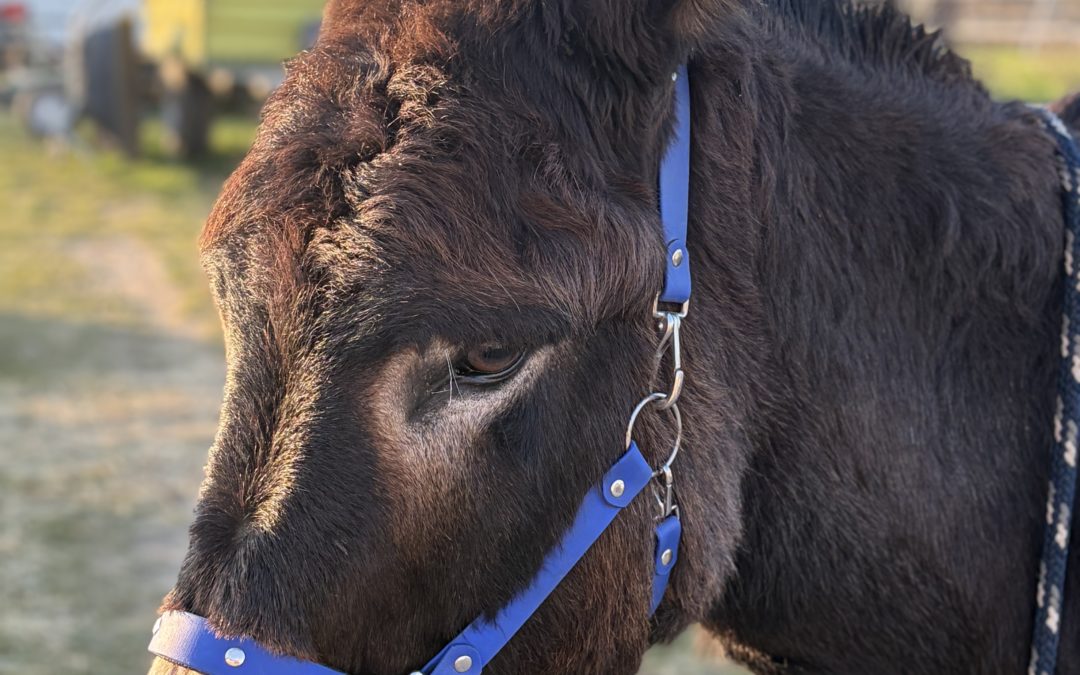
Balthazar, the donkey

Picture of Balthazar: my new friend at SurVojo.ch and teacher of healthy emotional expression

Resources:

  • Where to visit Balthazar: If you live nearby Binningen (CH), you can visit Balthazar (and Fabian) at the Sur Vojo farm (survojo.ch). You will find two Grand noir du Berry there – Balthazar is the smaller one. The other, and much larger one, is Lotus. 
  • This week’s song is Aerials, cover by The Barefoot Movement


The tyranny of the pursuit of happiness and purpose

The tyranny of the pursuit of happiness and purpose

I see many posts in my feed lately on how to help you “be more happy”, “find your purpose”, and urge you to “pursue your IKIGAI”—that magical intersect between what you love to do, can do, the world needs, and gets you paid… that ONE purpose in life that “can set you free”… but, does it really?

What if that’s all a mirage… another pop-psychology soundbite regurgitated to keep you blind to what already is…
… trapped in a fixed destination: the tyrannical pursuit of that ONE purpose, 
… stuck chasing unicorns in some impending future,
forgetting to live in the moment.

So, what’s my proposal?

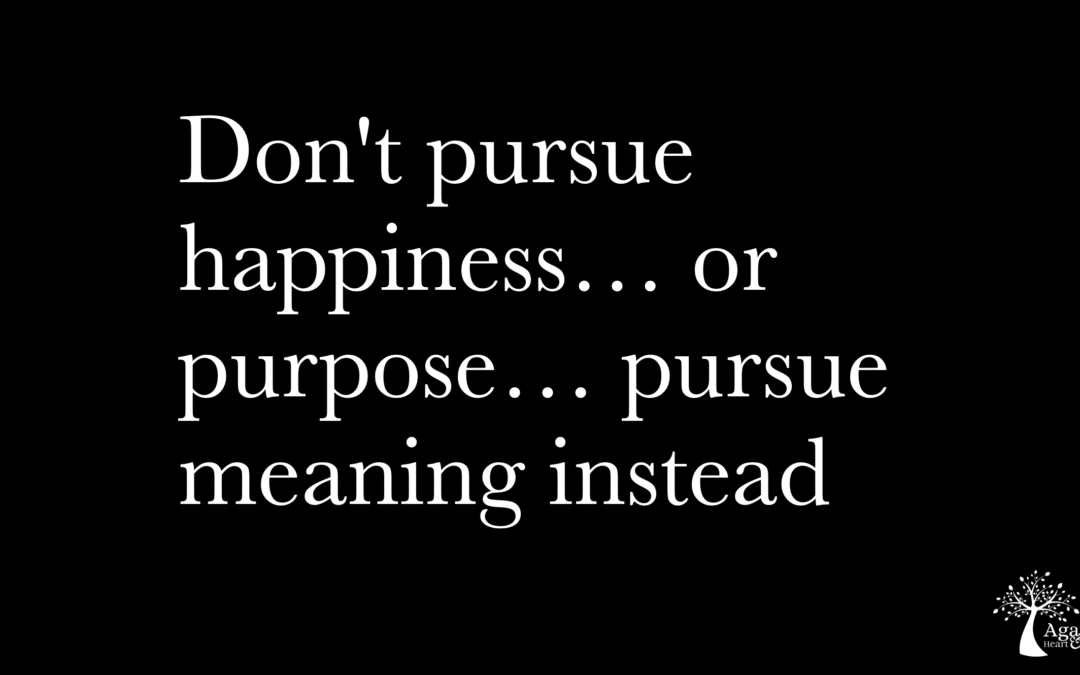
Don’t pursue happiness…
or purpose…
pursue meaning instead.

The beauty of meaning, as opposed to purpose, is that it’s not something you chase or declare once and for all. It’s something that emerges and evolves—
as you live your life, 
as you engage with the world around you, 
as you embrace the people around you.

Meaning is found in life itself… in every moment of every day.
And because meaning is ever so present, it seems fleeting.

You know how, when there’s a constant repeating sound in your environment, you stop hearing it? I remember, when I lived in Egypt, my bedroom overlooked a train station, and there was a long loud train whistle at least every 45 minutes or so. So, I stopped hearing it, and I would only notice it when my friends on the phone would complain about that loud long whistle in the background…

That’s what I think happens to meaning.

We don’t see it anymore, and therefore think it’s missing from our lives. Not because it’s not there, but because our mind is constantly engaged in that hypothetical future—the one that’s holding our salvation, finally fulfilling all of our hopes and dreams, and “sets us free”.

So, we get lost in that futuristic maze…
… start chasing that next dopamine kick,
and numb ourselves with soundbites that shine like diamonds but are hollow inside.

To be clear, I’m not suggesting we stop dreaming or hoping all together…

I’m suggesting that we focus on recognising meaning in what already is, first…
… in the circumstances we are already in,
… the roles we already play,
… the people who are already in our lives.

I make a living supporting those who find themselves in a place of transition. Sometimes that transition is forced upon them by an employer or life in general. But many of them choose to pursue something different that can hopefully fill a sense of void or confusion or longing…

And my job is to help them first understand “what is”, so that they can step into “what can be” with much more clarity and, dare I say, purpose. But that purpose is not the same as your IKIGAI… It’s a sharpened perspective…

Here’s a final thought on meaning.

When we pursue it, it doesn’t promise eternal bliss or comfort… in fact, it can get terribly uncomfortable—at times even painful. But it does promise us this: drive, energy, passion, determination, stamina, resilience to walk the mile… a sense of being “whole”… and, if we can pay enough attention to its sound, in the “here and now”, it can give us wings to explore the unchartered… and literally “set us free”…

Having said all that,

if meaning is still not enough for you, and you really, really, want to understand your ONE purpose in life—here’s one for you:

LOVE.

That’s our one and only purpose: to learn how to love one another—unconditionally. AGAPE—that’s our purpose.

How we get there?

That’s life.
Your life. My life. Our life.
And the meaning we make of it—
every moment of every day.

Here’s to a meaningful 2026!

PS: No AI has been used or harmed in the writing of this post. All em-dashes and stream of consciousness are my own.

Recommended resources: 

“You will never make it without anti-depressants” she said. (part II)

“You will never make it without anti-depressants” she said. (part II)

In my first post titled You will never make it without anti-depressants” (part I), I spoke to you about my burnout and what helped me through it. And for three years, I felt content, complete, and hopeful that I would never have to go through something like this again.

All was Quiet On The Western Front… 

… until the day I found myself in London (UK), attending a Stress Management class.

Thirty minutes into the session, the building started shaking. The instructor explained we had nothing to fear – they were digging in a nearby site and all was safe. 

By mid-day, my hands felt cold as ice. So, I wrapped myself in my jacket and scarf. I was freezing, even though my fellow training participants seemed comfortable in their light autumn garments.  Throughout the day, I felt a general sense of unease, and was relieved when the day was finally over and I could get back to my hotel room.


A yellow I want you to panic! sign on wooden background.
Photo by Markus Spiske on Pexels

Panic attack

As soon as I got into my room on the ground floor, I started having palpitations. My heart was racing. My chest was tight. My breathing was fast and shallow. I felt dizzy, and my mind was in a haze… 

I was having a panic attack. 

I tried to calm my mind. Tell myself that I was safe. Take deep breaths. To no avail. My body was hijacked in a flurry of panic and confusion. Followed by a flood of diarrhoea. I was scared. Confused. My legs felt weak. No matter how I tried to reason with my body that all was well – it wouldn’t listen. It was on overdrive, and I had no means to control it. 

I felt like I was losing my mind. 

I called my international health provider who suggested I go to a nearby clinic – but what for? I knew there was nothing physically wrong with me. I didn’t need a Doctor. I needed a comforter. 

So I called my mom. 

I told her what was happening, and she stayed with me on the phone for over an hour. Soothing me. Praying for me. Until it was time to go to bed. 

Eventually, the heart palpitations slowed down, and I was able to fall asleep. But it was a bumpy night, mainly because I was afraif of having another panic attack in the middle of the night.

The next day

When I woke up the next day, the sheer idea of having to go back to that training building made my stomach churn. So, I re-scheduled my flight for one leaving that same day in the afternoon, and I told my teachers I was unwell and won’t be coming back to class. Then I checked-out and headed to a nearby park. 

Being in nature has always had a calming effect on me. I sat on the green grass. Watched the tree leaves flutter in the wind. Gazed at the sky. Breathed and prayed. Then I dragged myself on the Tube to the airport, and somehow made it through the flight back home. 

The whole day I spent in fear of a second panic attack, which never materialised. 

I had never had a panic attack before – not even during my burnout. And the irony that all of this happened while being on a STRESS MANAGEMENT class was not lost on me!

It’s uncomfortable, but not dangerous

While I never had another panic attack, that incident shook me at my core, and I found myself falling into a mini-depression for about a month. Once again, I was reminded of just how fragile I was, and how temporary feelings of anxiety or even depression will most likely keep coming in and out of my life. The Yin to my Yang …

I went to see my former psychotherapist.

She explained to me how panic attacks work, and reassured me that they ALWAYS pass. In fact, she said that people who get frequent panic attacks are better off waiting it out rather then combatting it with medication or even trying to “rationalise” the experience as I did in my hotel room.
“When you allow the body to go through the full panic cycle naturally (also called “flooding”), panic attacks can stop after 10-20 minutes vs. hours (as in my case)”, she said. “Often, they don’t come back. And if they do, they become less intense and less frequent” (here an insightful video by Dr. Harry Barry on the subject).

I felt a huge sense of relief to know that panic attacks, while very uncomfortable, are not dangerous, and that they always pass. 

Christ Church Cathedral in Christchurch, New Zealand
Christ Church in Christchurch, New Zealand

An old trauma revived

As I explored with my therapist the possible reasons for my panic attack, I realised that two main factors had contributed to that moment. 

1. The shaking classroom in London had revived in me an old trauma. 

In 2012, I woke up in a hotel room in Christchurch, New Zealand, to a thundering rumble and a building that was swinging like it was made out of cardboard. I grabbed our baby daughter, who was asleep next to me, in panic, and together with my husband we ran outside. The earth under our feet and everything around us was rattling. I held our daughter ever so tightly. 

It was New Year’s Eve. 

We kept experiencing one after-shock after the other that day. Massive black stones roared as old church buildings shook. I remember feeling a general sense of panic and fear all day, and throughout the night. Thankfully, my husband remained calm and composed through it all. 

2. Counselling employees on long-term sick leave.

Working as a Case Manager and Counsellor that year seemed to have taken a toll on me. While I loved and deeply cared for my work and my clients, I had to come to the conclusion that my high sense of empathy was a double-edged sword. My inability to keep a healthy boundary between my clients’ heart-wrenching life stories and my own, was pulling me down into a rabbit hole I knew I did not want to lose myself in. 

Hard decisions were in order

I worked on my old Christchurch trauma with my therapist.

I told my counselling managers that I will not be extending my temporary counselling assignment for another 6 months. Instead, I would stop by end of year as originally planned. 

And, after a long soul searching, and with the support of my coaching supervisor, I decided not to pursue my second year diploma in Coaching. It would have implied flying back to the UK within four weeks, while I was still feeling shaken. Not to mention the long nights studying and writing assignments that I knew were awaiting me.

I was yet again trying to do too much… I needed to be kind to myself and set priorities.

Highlighted Bible verse in Bible Romans 8:28: And we know that all things work together for good to them who love God, to them who are the called according to His purpose

All things come together for the good

This is one of my favourite Bible verses:

“And we know that all things work together for good to those who love God, to those who are the called according to His purpose.” – Romans 8:28

Did I enjoy having a panic attack? Definitely not! But it ended up being my saving grace in many ways: 

1. It allowed me to start a healing process of my Christchurch trauma. 

2. It saved me from 6 months of turmoil and heartache, had I accepted that counselling assignment extension. A series of unfortunate events led to the dismantling of that team at the end of December, a few days before Christmas. Had I extended my assignment, I would have found myself in a very unfortunate and miserable situation. 

3. Thanks to a highly empathetic school director, I was able to pass my Stress Management class remotely. 

4. Instead of pursuing another general diploma, I got to focus my time and energy on specialised coaching trainings instead, such as Strengths coaching, Gestalt coaching, Team coaching and Non-Violent Communication. This turned out to be the more appropriate and fruitful path for me, and I’ve never regretted my decision. 

5. Finally, all of the above allowed me to pursue a new career path as an individual-, strength- and team- coach, and workshop facilitator.

Once again, God had proven himself faithful and merciful unto me and my family. 

One day at a time

The old me would have been very harsh on myself – judging every one of my decisions as a Loser’s decision. A Coward’s decision.

How can you give up so quickly – what’s wrong with you? 

What do you mean you’re taking an earlier flight and dropping a class you’ve been looking forward to for months? 

What do you mean you’re giving up on your counselling dream and not extend your stay with the team?

What do you mean you’re going to withdraw your coaching diploma application – which you already paid for by the way?!

But the truth is: Not taking the decisions I took would have been the real act of cowardice.

Not listening to my body and what the panic attack was trying to communicate to me would have been foolish.

By listening to my gut, and doing what felt right deep within my soul, I not only honoured my needs at the time, but it also led me on an alternative path. A path which tunred out to be much more fulfilling than my original plan.

It’s now been three years since my panic attack, and I haven’t had another one since. Part of me worries about it possibly happening again. And I do seem to have developed a fear of flying since then… Oh well! 🙂

For now, I’ve decided to take things one day at a time – riding the waves of life as they present themselves.

Recommended resources: