Peeling the Onion: My first published article about Gestalt—and the story behind it

Peeling the Onion: My first published article about Gestalt—and the story behind it

My first published article is out! And yes, I’m very proud. 😊

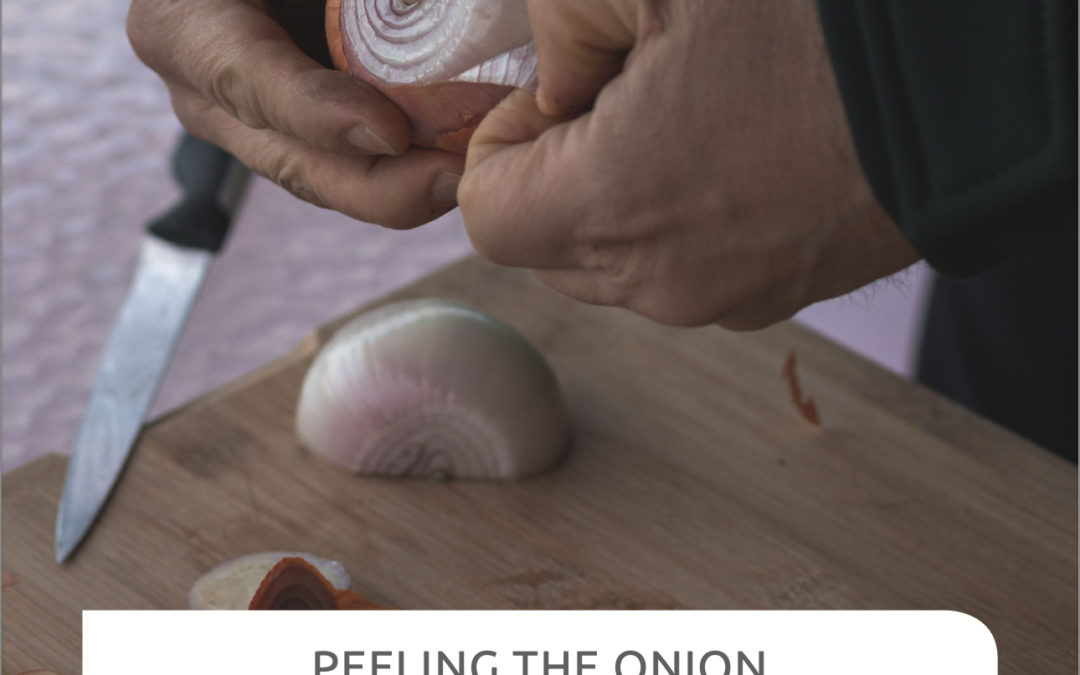
🧅 “Peeling the Onion—A Gestalt Perspective on the Art of Reflection” appeared in the October issue of Coaching Perspectives, the magazine of the Association for Coaching (AC).

In it, I explore reflection as a whole-person experience: feelings, sensations, the body, creative experimentation, and what happens between coach and client.

Researching and writing it deepened my understanding of Gestalt—and got me even more excited about it, if that was at all possible 😄.

But before I share my article, let me take you on a trip down memory lane—how NOT to write an article… 🙃

How NOT to write an article for a magazine

🐣 First, find every book there is on the topic and mark 25 as favourites.
🐣 Read every single one, including chapters that have nothing to do with your article.
🐣 Start checking out the bibliographies of said books and cheerfully go down those rabbit holes.
🐣 Compile screenshots of interesting texts until you have 704 pages of material.
🐣 Start distilling this ginormous library into treasure troves, while carefully referencing. Three weeks later, you’ve distilled 704 pages into 34. Not bad.
🐣 20 days before submission, you start building your article’s outline. Congratulations, you’ve gone from 34 pages to 41!
🐣 Did I mention you were only commissioned for a max. 2’100 words—or 3 pages?
🐣 You spend every waking moment agonising over what to keep and what to cut. By version 5, you’re down to 10 pages. Six days to deadline.
🐣 The day before submission, you’re on version 9 and you have reached 1’998 words—hooray!
🐣 On D-day, you open your laptop before you’ve even brushed your teeth. Make tiny tweaks here and there; check the word count: 2’305. NO!
🐣 You’re back to cutting words. Finally: exactly 2’100. YES!
🐣 You finalise your endnotes and double-check your references one last time.
🐣 You start having a mini heart attack when you realise that some of the page numbers in one of your book references are totally off.
🐣 You spend the next 20 minutes correcting them, wondering how you could have possibly gotten so many wrong?!
🐣 You open your 704-page doc: there are two books with the same title but different publication years, with very similar contents in a different order.
🐣 You go back to your article and hope the “undo” button has enough juice to “beam you back”.
🐣 By now, your nerves are fried. You’re ready for a punishing session at your local gym—but you gotta send this off first.
🐣 You do a final read. Check references (again). Do a final word count: 2’103. Too bad, those extra 3 words will have to stay in before you have a nervous breakdown.

You write the email. You hit SEND. 🐥

My article opens with this quote by Fritz Perls:

“Lose your mind and come to your senses”.

If only I had taken his advice…

🌿 What made it into the article

I explore Perls’ “peeling the onion” metaphor—the layers of contact, from social exchanges to the roles we play to the vulnerability of allowing ourselves to be seen.

For there, I discuss five Gestalt skills that support reflection: staying in the here and now, noticing beyond words, moving beyond questions, creative experimentation, and an I-thou relationship. And throughout, I share examples of what this can look like between coach and client.

Fritz Perls was a bit of a “provocateur”. He was also unapologetic about what Gestalt is and what it isn’t:

💬 “A technique is a gimmick.”

And I wholeheartedly agree.

Gestalt taught me that tools and techniques become crutches when used as ends in themselves. This is why I encourage my Gestalt Lab participants to focus on what is happening between them and their clients in the here and now, allowing the relationship to inspire creative experiments—whatever form these may take.

In the article, I share practical examples of such experiments.

But whatever we invite our clients to do, I argue that it needs to come from a place of love—Agape. A willingness to meet the other in our full humanity, share something of ourselves, and be touched in return.

That takes courage.

That willingness to meet and be met is also at the heart of my Gestalt work and the Gestalt Coaching Practice Labs I’m launching in February 2027.

📌 Read “Peeling the Onion—A Gestalt Perspective on the Art of Reflection” here.
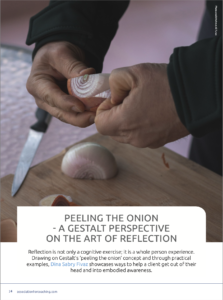
Image of Dina Sabry Fivaz' published article: “Peeling the Onion—A Gestalt Perspective on the Art of Reflection” in the AC's Coaching Perspectives magazine.

I’d love to hear what it stirs in you. And if you recognise yourself in my writing process, do tell me, so I don’t feel alone in my madness… 🤣

With love,
Dina 🫶🏽

Opening the door: Poetry, reflection, and relational coaching

Opening the door: Poetry, reflection, and relational coaching

cat looking out of a door. Black and white image by sosinda from Pixabay
Image by sosinda from Pixabay

Our Relational Coaching Circles are growing! 🌱

Since our community began on 1 March 2026, it has grown to 57 members, with more joining.

My deepest gratitude and thanks to you all for your trust, openness, vulnerability, and generous sharing of yourselves! Without you, there would be no community. ☀️

One poem, many different experiences

📗 In yesterday’s circle, we explored a poem, simply staying with the words and noticing their impact on each of us.

It always amazes me how the exact same words and images can touch us in such different, at times opposite, ways. Mind you, I shouldn’t be surprised: through my Gestalt lens, those differences make total sense. We each bring different experiences, histories, and contexts—different Ground and Fields. What becomes a figure of interest, how we interpret it, and the meanings we make will inevitably also be different…

We didn’t try to arrive at a shared interpretation or understanding. We simply stayed curious about what emerged for each of us, witnessing it with open hearts and ears.

💬 Those who wanted to had space to work in pairs, receiving peer coaching or exploring a client case on their mind.

As always, I forgot to ask the 11 wonderful participants if I could take a picture of their beautiful smiles 🙈. Hopefully, I’ll remember when we meet next time.

📌 If you’d like to explore the poem for yourself, you’ll find it in a dedicated section below, together with some reflection prompts. I’d love to hear what the experience is like for you. 🌻

An invitation to our next circle

📆 Our next Relational Circle—and our last of 2026—is on 16 December.

I’d love to see as many of you as possible! There’ll be no 12-participant limit that day.  The more, the merrier! 🎉

The 2027 dates are also already set, and I’ll share them soon.

📌 Want to join our community? Click here to find out more.

📌 Want to spend some time with the poem? Scroll down 👇🏽.

With love,
Dina 🫶🏽

📗 Your turn: “The Door”—poem and reflection

The Door

Go and open the door.
Maybe outside there’s
a tree, or a wood,
a garden,
or a magic city.

Go and open the door.
Maybe a dog’s rummaging.
Maybe you’ll see a face,
or an eye,
or the picture
of a picture.

Go and open the door.
If there’s a fog
it will clear.

Go and open the door.
Even if there’s only
the darkness ticking,
even if there’s only
the hollow wind,
even if
nothing
is there,
go and open the door.

At least
there’ll be
a draught.

—Miroslav Holub
from Poems Before & After: Collected English translations
(Bloodaxe Books, 2006)

📌 Reflection prompts: noticing what emerges

There’s no need to work out what the poem means or find something useful in it. These prompts are an invitation to stay with your own experience. Take your time, and have a pen and paper nearby to capture whatever emerges without overthinking it or censoring yourself.

1. Read the poem aloud

  • Simply savour the words and notice their impact as you speak them.
  • What do you notice in yourself? What was that experience like?

2. Read it aloud a second time

  • Which part of the poem stays with you—a word? an image? a sensation? Write it down.
  • As you stay with that word, image, or sensation: what voices, images, or thoughts come up for you? Write those down as well.
  • Pause and look at what you’ve written. What’s impact do your own words have on you in this very moment?
  • Now read your words aloud. What do you notice as you hear yourself say them?

3. Read it aloud a third time 

  • Is there a word or an image you feel some resistance towards?
  • Write it down, then note the qualities (positive or negative) that you associate with it.
  • If you’re willing, and ideally with someone else by your side, try expressing each quality as an “I am…” statement. Say each one slowly, noticing its impact on you.
  • You don’t need to agree with the statement or decide that it’s true. Simply notice what happens as you try it on.

4. Let someone witness your reflections

If you can, share your reflections with someone you trust—someone who can listen fully, without needing to interpret or solve anything.

For me, something magical happens when we allow our thoughts and emotions to be witnessed by another human being.

And if you’d like that person to be me, you know where to find me. ❤️

Gestalt coaching uncovered: Reflections on my Association for Coaching webinar

Gestalt coaching uncovered: Reflections on my Association for Coaching webinar

(Video excerpts below 👇🏽)

Some conversations leave you so energised that you just can’t wait to have more of them. 😊

That’s how I felt after leading “Ask Me Anything: Gestalt Coaching Uncovered” last week, hosted and facilitated by the Association for Coaching.

Headshot of Dina Sabry Fivaz, Master Gestalt Practitioner, and host of the Association for Coaching webinar

🎉 More than 140 coaches registered, and over 35 joined us live.

To everyone who took part: thank you for your generous presence, your insightful questions, and warm curiosity! 🫶🏽

And heartfelt thanks to Smaranda Dochia, Jane Webster and Lenka Klimova at the AC for hosting and facilitating this wonderful space.

My hope was that participants would feel something of the power and beauty of Gestalt Coaching—and leave curious about this way of experiencing ourselves, others, and the world. And given the feedback received after the session, I’d like to think “mission accomplished” ☀️.

What did we uncover?

The beauty of an “Ask me anything” format is that I arrive with no agenda and no slides—in true Gestalt spirit. This leaves room for what wants to emerge through the people in the room—the things they bring and that they’re genuinely curious about, in the present moment.

The questions took us through some of the foundations of Gestalt and into what it might look like in practice.

We explored:

  • What Gestalt means and where it comes from.
  • What makes it such an eclectic approach.
  • Figure, Ground, and Field
  • The cycle of experience, and how it gets interrupted
  • Awareness, choice, and our ability to respond

And, of course, I shared my favourite Gestalt mantra:

Movement creates difference.
Difference creates awareness.
Awareness creates choice.
Choice strengthens our ability to take responsibility for our lives—or, as Perls liked to say, our response-ability.

There was much to talk about. The questions and curiosity in the room made this mutual exploration a real joy. I could honestly have done this for half a day, not just 60 minutes 🙈.

Gestalt challenges us

Some of the questions we also explored concerned the importance of defining and achieving goals in coaching, measuring progress, and whether Gestalt is “therapy”. You’ll find some of my answers to those questions in the video excerpts below.

Behind these questions lie two things, in my view:

  • Our conscientiousness as coaches and our desire to be “good” coaches and act ethically.
  • Introjections—rules we may have swallowed whole without truly digesting them and making them our own.

I believe that, as coaches, we owe it to ourselves and our clients to be critical thinkers and, why not, philosophers 😊.

In my view, the coaching profession is still in its infancy, which also means that it is being continuously shaped, defined, and transformed by new thinking and experiences.

So, my invitation to every coach out there is to question every coaching mantra and “sacred cow”—including the ones I offer you on this page. Make sure that whatever you decide to espouse as a value or belief in your coaching practice has been fully digested and adopted with conviction—not just out of compliance or reverence for the one saying it.

“It gave me the confidence to try some things”

All 13 respondents to the overall rating question rated the webinar “Excellent”.

To the question “What did you find particularly useful in this session?”, one participant wrote:

“I just loved all of it. Some practical examples about what Gestalt coaching looks like in practice and how one might incorporate it. Really refreshing and gave me the confidence to try some things”

That last part means a great deal to me: “gave me the confidence to try some things”.

My goal is for coaches to find the courage to show up in the room—show up in that coach-client relationship—as the unique and beautiful individuals they are: with their thoughts, feelings, sensations, and even opinions. No masks. No roles. A relationship imbued with the spirit of Martin Buber’s I-Thou, as much as possible, of course.

Another participant shared:

“The energy that Dina created and her heartfelt explanations. They came from deep within and were hence very authentic”

And someone else wrote:

“All of it to be honest – probably the best webinar I’ve been to (and not just for coaching). Brilliant speaker, full of honesty, passion and willingness to share – properly engaging”

Gestalt means a lot to me. It’s transformed how I show up in the world and in my coaching work. And so, to hear that this passion may have come through and encourage others to find out more about Gestalt means the world to me.

And I admit that the occasional smiles and nodding faces were also a very welcome reassurance to the introvert in me.

What I’m taking into what comes next

The feedback also offered useful suggestions: some introductory reading to help participants arrive with a shared foundation, and making sure an individual question doesn’t become an extended one-to-one supervision conversation.

I appreciate that feedback very much. And in fact, I will already be able to apply it to my guest lecture that I plan to deliver next month on the University of Cambridge’s Certificate in Coaching programme.

And there was also clearly an appetite for more 😊:

“This session could have been two hours and I still would not have tired of it”

“I could have quite happily listened to Dina speak and answer questions for a whole afternoon”

I honestly felt the same way… When I left the call, I was on cloud nine, and that buzz stayed with me for the rest of the week.

Coming in 2027: Gestalt Coaching Practice Labs

My 2027 Gestalt Coaching Practice Labs and new introductory Gestalt videos are taking shape.

The wish to understand what Gestalt looks like in practice— and to feel confident enough to explore it—connects closely with what I want to offer through the labs: space to bring your curiosity, explore Gestalt ideas, experiment and reflect on how they inform your own way of coaching.

I’m also planning a Gestalt webinar series with the Association for Coaching in spring 2027. More opportunities to ask questions and explore together.

And I have a few more Gestalt-related projects up my sleeve… let’s see if they materialise 😊.

Curious to hear more?

🌱 If you’d like to be among the first to hear about my 2027 Gestalt Coaching Practice Labs, do join my CURIOUS list.

I’ll share more as the plans become ready.

Thank you again to everyone who joined the webinar, brought a question or took the time to share feedback. You’ve given me plenty to celebrate—and plenty to carry into what comes next.

With love,
Dina 🫶🏽

Watch four excerpts from the webinar:

1. Why I love Gestalt so much

2. What about goals in Gestalt & my personal Gestalt mantra

3. How do I know that I’m making progress as a Gestalt coach?

 4. Experiments in Gestalt Coaching: an act of bravery and love (agape)