
My first published article is out! And yes, I’m very proud. 😊
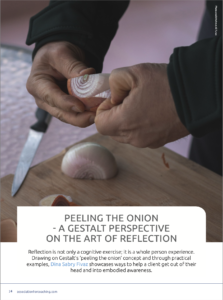
🧅 “Peeling the Onion—A Gestalt Perspective on the Art of Reflection” appeared in the October issue of Coaching Perspectives, the magazine of the Association for Coaching (AC).
In it, I explore reflection as a whole-person experience: feelings, sensations, the body, creative experimentation, and what happens between coach and client.
Researching and writing it deepened my understanding of Gestalt—and got me even more excited about it, if that was at all possible 😄.
But before I share my article, let me take you on a trip down memory lane—how NOT to write an article… 🙃
How NOT to write an article for a magazine
🐣 First, find every book there is on the topic and mark 25 as favourites.
🐣 Read every single one, including chapters that have nothing to do with your article.
🐣 Start checking out the bibliographies of said books and cheerfully go down those rabbit holes.
🐣 Compile screenshots of interesting texts until you have 704 pages of material.
🐣 Start distilling this ginormous library into treasure troves, while carefully referencing. Three weeks later, you’ve distilled 704 pages into 34. Not bad.
🐣 20 days before submission, you start building your article’s outline. Congratulations, you’ve gone from 34 pages to 41!
🐣 Did I mention you were only commissioned for a max. 2’100 words—or 3 pages?
🐣 You spend every waking moment agonising over what to keep and what to cut. By version 5, you’re down to 10 pages. Six days to deadline.
🐣 The day before submission, you’re on version 9 and you have reached 1’998 words—hooray!
🐣 On D-day, you open your laptop before you’ve even brushed your teeth. Make tiny tweaks here and there; check the word count: 2’305. NO!
🐣 You’re back to cutting words. Finally: exactly 2’100. YES!
🐣 You finalise your endnotes and double-check your references one last time.
🐣 You start having a mini heart attack when you realise that some of the page numbers in one of your book references are totally off.
🐣 You spend the next 20 minutes correcting them, wondering how you could have possibly gotten so many wrong?!
🐣 You open your 704-page doc: there are two books with the same title but different publication years, with very similar contents in a different order.
🐣 You go back to your article and hope the “undo” button has enough juice to “beam you back”.
🐣 By now, your nerves are fried. You’re ready for a punishing session at your local gym—but you gotta send this off first.
🐣 You do a final read. Check references (again). Do a final word count: 2’103. Too bad, those extra 3 words will have to stay in before you have a nervous breakdown.
You write the email. You hit SEND. 🐥
My article opens with this quote by Fritz Perls:
“Lose your mind and come to your senses”.
If only I had taken his advice…
🌿 What made it into the article
I explore Perls’ “peeling the onion” metaphor—the layers of contact, from social exchanges to the roles we play to the vulnerability of allowing ourselves to be seen.
For there, I discuss five Gestalt skills that support reflection: staying in the here and now, noticing beyond words, moving beyond questions, creative experimentation, and an I-thou relationship. And throughout, I share examples of what this can look like between coach and client.
Fritz Perls was a bit of a “provocateur”. He was also unapologetic about what Gestalt is and what it isn’t:
💬 “A technique is a gimmick.”
And I wholeheartedly agree.
Gestalt taught me that tools and techniques become crutches when used as ends in themselves. This is why I encourage my Gestalt Lab participants to focus on what is happening between them and their clients in the here and now, allowing the relationship to inspire creative experiments—whatever form these may take.
In the article, I share practical examples of such experiments.
But whatever we invite our clients to do, I argue that it needs to come from a place of love—Agape. A willingness to meet the other in our full humanity, share something of ourselves, and be touched in return.
That takes courage.
That willingness to meet and be met is also at the heart of my Gestalt work and the Gestalt Coaching Practice Labs I’m launching in February 2027.
📌 Read “Peeling the Onion—A Gestalt Perspective on the Art of Reflection” here.
I’d love to hear what it stirs in you. And if you recognise yourself in my writing process, do tell me, so I don’t feel alone in my madness… 🤣
With love,
Dina 🫶🏽
Recent Comments