How career experiments helped me find my way back to HR

How career experiments helped me find my way back to HR

Exploring a career beyond Human Resources

It took me two years away from Human Resources (HR) to realise it was still my home.

I don’t regret those two years. Without them, I would always have wondered: “What if?”

Last week, I shared how a humanitarian training helped me realise that area wasn’t for me.

But I had another dream still to explore: Human Rights.

So, I ran another experiment. Then another.

🌱 Newsletters and online forums. Loved it.
🌱 A summer diploma in Economic, Social and Cultural Rights, including attending the UN Commission on Human Rights in Geneva. Amazing.
🌱 Six months in Serbia, leading an HR project while participating in the organisation’s Human Rights initiatives. A once-in-a-lifetime experience.

☀️ Each experiment helped me take the next step. ☀️

My husband wasn’t keen on a life of moving between field missions, so I focused on Geneva-based jobs.

An unexpected opportunity at the UN

I applied for an internship at the Office of the High Commissioner for Human Rights.
Everyone I knew said I wouldn’t get in without connections.
I got two calls.

The first came while I was on holiday. By the time I heard the voicemail on Saturday, the Friday deadline had passed. I called on Monday. They’d offered it to someone else.

I was gutted. Convinced I’d blown it.

Then, a few days later, another unit called: the NGO Liaison Office.
I said yes immediately.

🌱 Had I answered the first call, I would have ended up in a “back-office” role. Instead, I found myself right in the middle of the action.

☀️ Sometimes, God or the universe, whatever your belief, helps us a little. We just don’t recognise it right away. ☀️

An unpaid internship became a paid consultancy—and a year and a half that taught me so much.
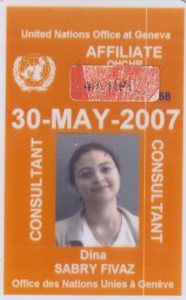
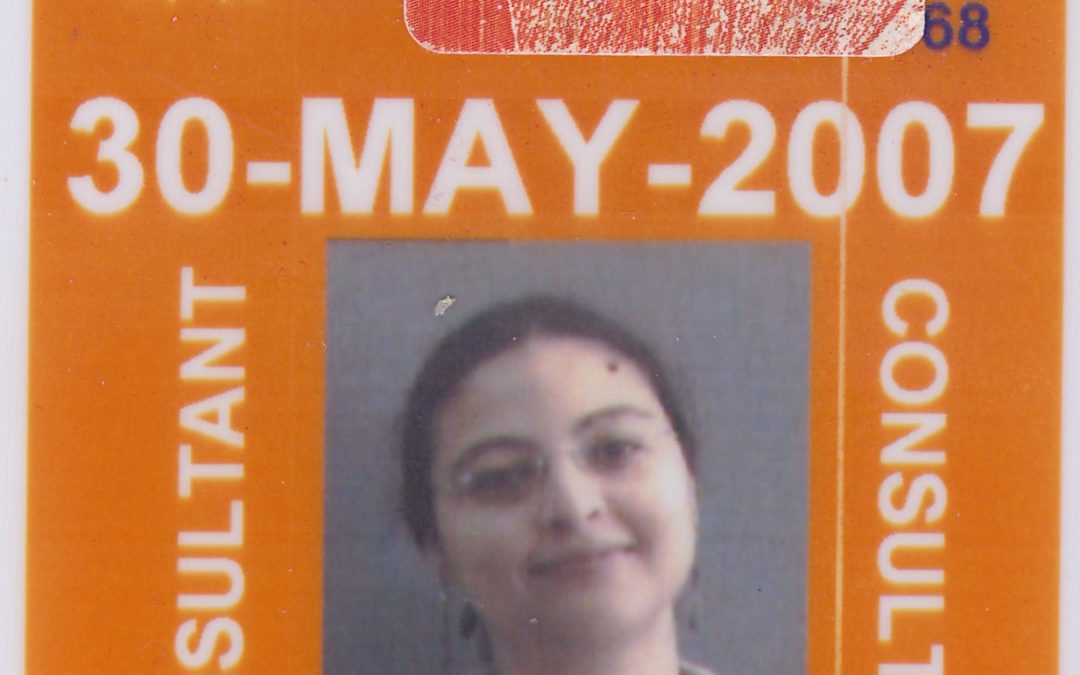
picture of Dina Sabry Fivaz's UN badge as an OHCHR consultant

I helped facilitate NGOs’ participation in the newly established Human Rights Council so their voices could be heard.

I met inspiring rapporteurs and activists, including people risking their lives to speak out.

I loved the cause, the work, and the people.

But by the end, I also knew:
🌱 I needed more stability than temporary contracts offered.
🌱 The political sensitivities—and the constant care over what I said, how and to whom—took more energy than I wanted to give them.
🌱 Staying in Switzerland, I could see a way to make the more direct, immediate contribution I was looking for through HR.

Human Resources was still my home. I just needed a different area within it.

📌 You can’t think yourself through a career transition.

Those two years gave me clarity, unforgettable experiences, and relationships I still cherish today.
The experiments let me test the “what if” and choose my next step with a clearer understanding of what mattered to me.

What happened next is for next week. 😊

☀️ If you’re in pharma trying to figure out your next career step, I’ve been there myself. Today, I help people explore that question—not by rushing towards an answer, but by finding ways to test what might fit. ☀️

Explore career coaching for Pharma professionals. 

With love,
Dina 🫶🏽

More posts in this career-exploration series:

    CV tip: How long should your CV be?

    CV tip: How long should your CV be?

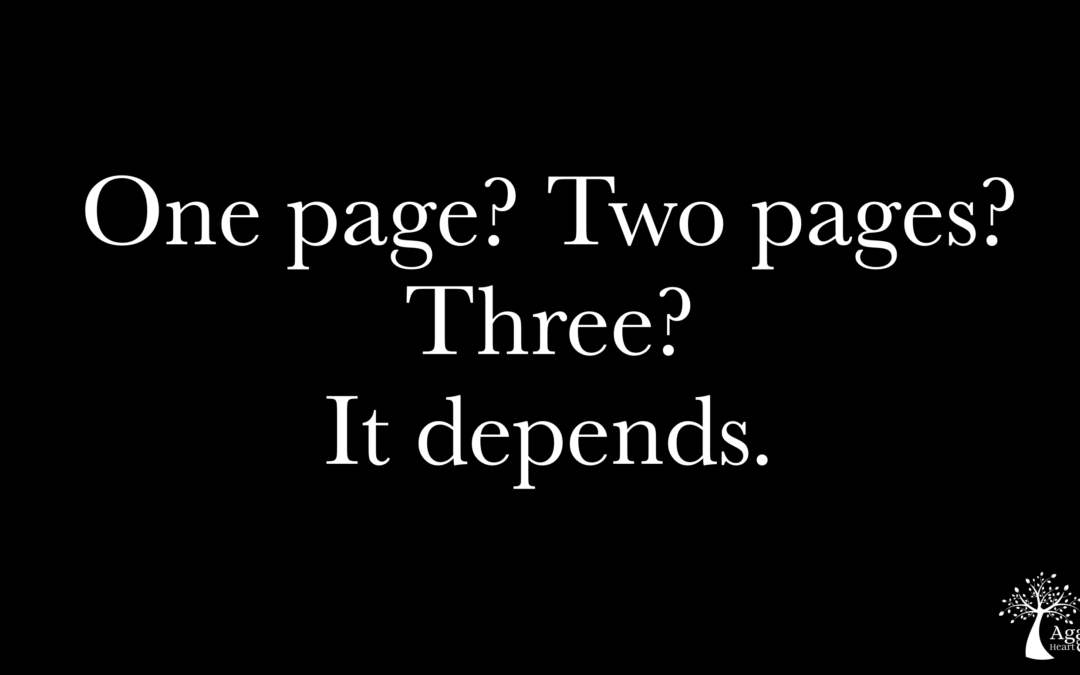
    “Your CV has to fit in one page.”
    “Your CV must never be longer than two pages.”

    I hear these rules constantly—from people I coach, from friends, and sometimes as advice they’ve received from other coaches.

    And honestly, they drive me a little insane.

    In my 20+ years in HR in Pharma, I’ve never seen such black-and-white advice work. The truthful answer is: it depends.

    image text reads: One page-two pages-three-it depends

    🌱 For an intern or someone early in their career, one page is often more than enough.

    🌱 For a mid-level professional, two pages often make sense, but I’ve also seen cases where three were necessary.

    🌱 For a senior professional, three or more may be justified, depending on their background, the target role and whether publications or other relevant evidence need to be included.

    🌱 In a career transition, your CV may need to work harder to explain your qualifications and motivation, which may also lead to a two- or three-page CV.

    So, instead of asking “How long should my CV be?”, ask:

    1. 📌 Have I focused on the most relevant information to get me noticed for this role?
    2. 📌 Have I made that relevance already clear on page one?

    ☀️ That first page is precious real estate.☀️

    Pharma recruiters have told me they estimate they spend around 10 seconds on an initial CV scan deciding whether to keep reading or move on to the next one.

    In a 2018 eye-tracking study by StepStone Austria and MindTake, 33 HR professionals spent an average of 43 seconds screening a CV.

    I’m not sure how far the Austrian study applies to today’s pharma market—regardless—both give you an idea of how little time you may have to catch someone’s attention.

    Writing a CV is like writing a marketing headline: every word needs to earn its place.

    Your first page should quickly answer:
    🌱 What is my professional identity?
    🌱 What expertise do I bring?
    🌱 What outcomes have I delivered that are relevant to this role?

    A three-page CV might use the first two pages for professional experience, with education, further training, languages, and other skills on page three.

    If you’ve caught the reader’s attention and shown them relevant experience, they’ll have a reason to keep reading.

    And if an MSc, PhD or PMP certification matters for the role, make it visible in the top third of your CV. There are many elegant ways to do so.

    How to build that first page is for another post.

    For now, before cutting useful evidence simply to meet a page limit—or sending a CV laundry list of everything you’ve done under the sun—ask:

    📌 Does this information help the reader understand why I’m a good fit for this role?
    📌 Does my first page make my relevance clear, giving the reader a reason to turn the page?

    With love,

    Dina 🫶🏽

    P.S. Once a week I try to focus on helpful CV tips. Anything you’ve always been curious about? Let me know in the comments and I’ll try to cover them next.

    Your weekly poem: Wild Geese

    Your weekly poem: Wild Geese

    🌿 A poem a day keeps the blues away… 

    WILD GEESE—or when feeling stuck is part of the process 🌿

    🌻 (…) Tell me about despair, yours, and I will tell you mine.
    Meanwhile the world goes on.
    Meanwhile the sun and the clear pebbles of the rain
    are moving across the landscapes,
    over the prairies and the deep trees,
    the mountains and the rivers.
    Meanwhile the wild geese, high in the clean blue air,
    are heading home again.
    Whoever you are, no matter how lonely,
    the world offers itself to your imagination,
    calls to you like the wild geese, harsh and exciting —
    over and over announcing your place
    in the family of things. 🌻

    —Mary Oliver

    🌱 Tell me about despair, yours, and I will tell you mine.

    If you’re thinking about a career change or are in the middle of one, you may recognise this particular kind of despair.

    • The despair of feeling stuck in a hamster wheel and seeing no way out.
    • The despair of being in a fog, not knowing where to go next.
    • The despair of looking for a job in an unforgiving market, with no end in sight.
    • The despair of being 40 or 50 and still not knowing what you want to be when you grow up.

    It can feel as though your life has stopped moving.
    As though everyone else is progressing, while you’re running hard just to remain in the same place.

    Movement beneath the surface

    But Oliver’s repeated “Meanwhile” invites a different way of looking at that stuckness: Even when we think we’re stuck, there’s movement.

    Just because movement is not visible to us doesn’t mean it isn’t happening.

    A career transition can be like that.

    On the outside, it may look as though nothing is changing.

    • You may still be in the same job,
    • going to the same meetings to have the same old conversations,
    • sending the same applications,
    • having the same doubts,
    • waking up with the same questions.

    But underneath, Oliver tells us:

    🌱 The world goes on

    —and something is always shifting.

    • An old idea of success may be loosening.
    • Your definition of who you are, and what you want, may be shifting.

    This void you find yourself in right now is a fertile void: the space in which new life can finally form.

    The chrysalis

    Chrysalises have always fascinated me. In fact, they’ve become a metaphor for how I understand career and life transitions:

    Transitions are the chrysalis from which new life can form.

    As a child, I used to wonder what was happening to the caterpillar inside. After all:

    • It’s just there.
    • It doesn’t move.
    • It doesn’t eat.
    • Is it aware that its body is reorganising itself inside its shell?
    • Is it aware that it’s using stored energy to break down and rebuild much of its caterpillar body into something utterly new?

    This biological process is called “metamorphosis” because the transformation is so complete that what emerges is unrecognisable from what came before.

    The same can happen during a career or life transition.

    That is why the line:

    🌱 the world offers itself to your imagination

    feels like the poem’s punchline.

    Your transition is not about what you already know. It’s about what might be possible, while trusting that something may still be making its way towards you.

    When we’re exhausted, disappointed or afraid, we often make decisions only on the evidence in front of us.

    • The job market says no.
      Our experience is too specific or too broad.
      Our age feels like a disadvantage.

    Our confidence has been worn down by rejection. And the fog keeps so much out of sight.

    But if we allow ourselves to welcome the fog and the void as fertile ground for metamorphosis, the waiting and the apparent lack of movement become more bearable.

    And we may become able to consider an alternative view:

    ☀️ What if I’m not behind, but in the middle of becoming?

    Harsh and exciting

    The call of the wild geese is

    🌱 harsh and exciting.

    Harsh—because transformation is rarely easy or comfortable. It’s frustrating, risky, scary and full of uncertainty.

    Exciting—because every transition carries the possibility of becoming something new.

    Like the caterpillar, we may not yet be able to see what is taking shape. But something is happening inside the apparent stillness of the chrysalis.

    📌 So, if you’re feeling stuck in your career or life in general, remember:

    the absence of visible movement is not proof that nothing is changing or moving.

    You’re standing in the midst of your own fertile void.

    So, take heart (and if you can: rejoice), for metamorphosis is in the making.

    🦋 Happy Sunday everyone! 🦋

    With love,

    Dina 🫶🏽

          Resources:

          • Read Mary Oliver’s full poem “Wild Geese” here: https://allpoetry.com/poem/15374223-Wild-geese-by-Mary-J-Oliver
          • This week’s song is an instrumental piece by Philip Glass called METAMORPHOSIS (1988). It’s 33 minutes long, and its repetitive, slowly shifting music evokes the spirit of the poem and this week’s reflections. I’d even encourage you to play it while you’re reading this blog post.

          Career change strategy: Different moves need different approaches

          Career change strategy: Different moves need different approaches

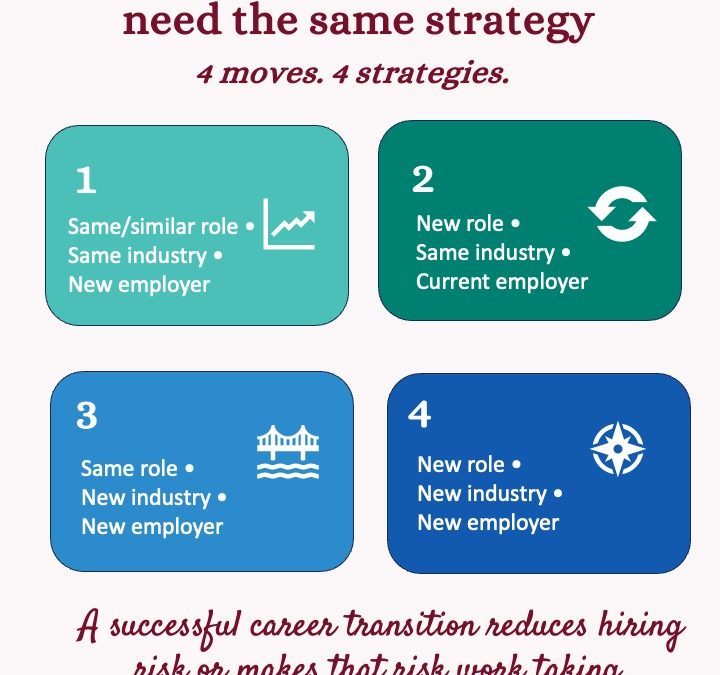
          Not all career changes are equally difficult.
          And not every career move needs the same strategy.

          There’s a difference between moving to:
          1️⃣ Same/similar job, same industry, new employer
          2️⃣ New job, same industry, current employer
          3️⃣ Same job, new industry, new employer
          4️⃣ New job, new industry, new employer

          The bigger the career change, the harder you need to work to create a bridge between what you’ve done and where you want to go. And the more a genuine human connection can matter.

          4 types of strategies for 4 types of career transitions

          ☘️ Here’s how I think about it:

          1️⃣ Same/similar job, same industry, new employer

          Usually the most straightforward move.

          • You have relevant experience,
          • Speak the industry’s language, and
          • Have a proven track record.

          Your challenge is positioning: targeting the right employers and roles, showing relevant achievements, and making your value easy to see.

          2️⃣ New job, same industry, current employer

          Often the most accessible lateral move.

          • You know the company, its stakeholders, and its language.
          • People know you, can recommend you, and can help you understand what the hiring manager needs.
          • You’re already inside the company, making it easier to network, reach out to decision-makers, do an internal rotation, and open doors.

          3️⃣ Same job, new industry, new employer

          The difficulty depends on how transferable your role is.

          • In IT, HR or Finance, core skills may travel more easily (see Category 1)—you still need to explain your motivation for the new industry.
          • Technical and scientific roles may prove to be trickier (see Category 4).

          4️⃣ New job, new industry, new employer

          This is the most demanding move, because you’re asking someone to take a chance on you without direct experience in either the role or the sector.

          This is where your strategy needs to be deliberate, and where creating a genuine human connection matters most:

          • Run mini-experiments to test the direction, gain evidence, and widen your network within the new industry.
          • Build missing competencies through a course, project or further education.
          • Find ways to be seen in action: short-term or pro bono mandates, events, conferences, LinkedIn.
          • Write a motivation letter, even if it’s not required. Make it personal and specific.
          • Send spontaneous applications—an underrated strategy but effective in Switzerland.
          • Humanise your CV. Include a relevant thread from your background, career decisions or meaningful interests. In DACH markets, you may also consider a professional photo.
          • Make a Category 1 move first, then a 2.

          👉🏽 So, if you’re looking for your next step:

          1. Identify the move you’re making
          2. Build the evidence, relationships, and story that match it.
          A successful career transition either reduces the risk someone feels when they consider hiring you OR makes that risk worth taking.

          📌 Which of these four moves are you considering right now?

          📌 What successes or difficulties are you facing?

          With love,

          Dina 🫶🏽

          Career experiment: How I discovered my dream job was not for me

          Career experiment: How I discovered my dream job was not for me

          The best career experiment I ever ran confirmed that my dream job was absolutely not for me.

          For years, I had dreamt of working in either the humanitarian or human rights field, but I did not know enough about either to know whether it was really a good fit for me.

          So, when I left a good job at Novartis because it no longer felt right, I decided to use the opportunity to explore humanitarian work first.

          I looked for a low-risk experiment to test things out and came across a week-long training programme run by an NGO, the Irish Humanitarian Response Network (IHRN), for people interested in humanitarian work.

          It felt like the perfect mini-experiment:

          ✅ Learn what the work is really like
          ✅ Meet others interested in or experienced in the field
          ✅ Connect with tutors and experts
          ✅ Test my interest before making a bigger commitment

          What I did not know was that the course took place in partnership with the Irish Defence Forces in Maynooth.

          ‼️ And on Day 5, we had a simulated war zone on site. ‼️

          We were split into groups of humanitarian workers responding to a crisis in a conflict zone.

          • We dealt with war victims.
          • We spoke to journalists.
          • We met officials who tried to pressure us into taking sides.
          • And, most memorably, we were “kidnapped” at machine-gun point, yelled at, held hostage for what felt like ages, and made to walk barefoot through the freezing cold back to base camp.

          Even though I knew it was a simulation, it was one of the most vivid and terrifying experiences of my life.

          I left that training knowing two things unequivocally:

          1️⃣ I had a much clearer understanding of what this work demands—and even greater respect for the people who do it.

          2️⃣ I reached a crystal-clear decision: this type of work was not for me.

          It was some of the best money I’ve ever spent.

          Not because it gave me a new career direction, but because it prevented me from investing years, energy and identity in a path that was never right for me in the first place.

          This is what I meant last week by the value of mini-experiments.

          They don’t always confirm the dream.

          Sometimes, their greatest value is showing you —early, safely and relatively cheaply—that your dream may need adjusting.

          A small experiment can save you from a big detour

          ☘️ A small experiment can save you from a big detour.

          With love,
          Dina 🫶🏽

          P.S. Next week, I’ll share the next experiment I conducted. 😊

          More posts in this career-exploration series:


            CV tip: How to write a CV that doesn’t sound like a job description

            CV tip: How to write a CV that doesn’t sound like a job description

            Your CV should not read like a job description.

            If you’re a specialist with a clear target role, relevant experience and a well-written CV–but you’re still not getting interviews–this may be why.

            Most CVs I see describe what someone was responsible for:

            • Managed X
            • Coordinated Y
            • Supported Z
            • Led meetings
            • Prepared presentations

            There’s nothing inherently wrong with that. But to stand out, you want recruiters and hiring managers to understand:

            📌 What difference did you make?

            For example:

            ❌ Managed the preparation of regulatory submission documents.

            To move beyond task-based bullet points, here’s one question that can help:

            📌 So what?

            In other words: Why should anyone care? Why does this matter

            **Let’s take our earlier example & follow that thread**

            🌱 Managed the preparation of regulatory submission documents.

            So what?

            🌱 It was a complex simultaneous submission for two major markets: EU & US.

            So what?

            🌱 Different authorities required different inputs, and the work had to be completed quickly to get ahead of a competitor.

            So what?

            🌱 The submission was delivered on schedule, approved in both markets, and helped make the treatment available to patients.

            ⭐️ Now we have the substance for a stronger bullet ⭐️

            ✅ Led a complex simultaneous regulatory submission for the EU and US markets, coordinating distinct Clinical, Safety and Technical Operations requirements under a time-critical deadline–securing approval in both markets before a competing product launch.

            Obviously, only make claims that are true and that you can substantiate in an interview. Otherwise, you could also say:

            ✅ Led a complex simultaneous regulatory submission for the EU and US markets, coordinating distinct Clinical, Safety and Technical Operations requirements under a time-critical deadline–securing approval in both markets and enabling a timely product launch.

            Cv tip: what difference did you make? so what?

            **So, a useful formula is**

            📌 What you did + context or complexity + outcome / impact

            You may have also noticed that not every achievement needs a percentage or a dramatic “saved X million” conclusion.

            ⭐️ Impact can be measurable or observable ⭐️

            • A process became clearer or faster by X.
            • A risk was identified or reduced by Y.
            • A difficult project moved forward or delivered in X time rather than Y.
            • A stakeholder was persuaded or X patients were reached.

            The point is not to make your role sound grander than it was. It’s to make the value you created visible.

            **So, take one bullet point from your CV today and ask yourself**

            📌 Does this tell the reader what I did–or what changed because I did it?

            So what?

            ⭐️ Specificity is (almost) always your best friend 😊 ! ⭐️

            With love,

            Dina 🫶🏽

            P.S. Next week, I’ll tackle a persistent CV myth: the one-pager.

            P.P.S. Once a week I try to focus on helpful CV tips. Anything you’ve always been curious about? Let me know in the comments and I’ll try to cover them next.