
STAR ⭐️, CAR 🚗, HERO 🦸🏽♀️, and my own approach, PIE 🥧—four ways to tell your story, and why I prefer bringing impact forward for more senior roles.
There’s no shortage of acronyms when it comes to ways to prepare for an interview:
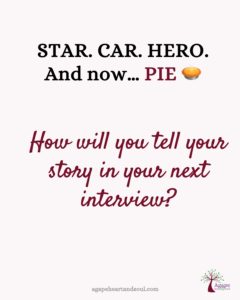
STAR – CAR – HERO – and I’ve decided to throw my hat in the ring as well with 🥧 PIE 🥧!
Let’s take them one by one.
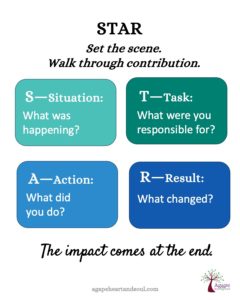
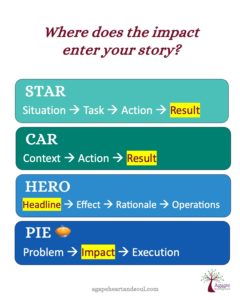
⭐️ STAR stands for ⭐️:
🌱 Situation: what was happening?
🌱 Task: what were you responsible for?
🌱 Action: what did you do?
🌱 Result: what was the outcome of your actions? What did you learn?
🚗 CAR stands for 🚗:
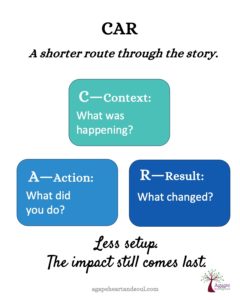
🌱 Context or Challenge: what was the specific situation or problem?
🌱 Action: what did you do?
🌱 Result: what was the outcome or impact?
Both are useful ways to structure your answer.
The challenge? Getting so caught up in the background that five minutes later, you’re still setting the scene… So, when using STAR or CAR, the key is to keep it short. Your interviewer can always ask for more detail if they need it.
Over time, however, I’ve found that STAR and CAR are most suitable for professionals early in their careers.
Why I prefer a different approach for senior roles
📌 For mid- to senior-level professionals, they don’t quite cut it in my view. For these kinds of roles, I would recommend exploring HERO, which I came across through Farah Sharghi, or my own approach, PIE 🥧.
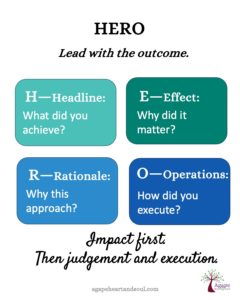
🦸🏽♀️ HERO stands for 🦸🏽♀️:
🌱 Headline: What was the outcome? One sentence that grabs the interviewer’s attention.
🌱 Effect: Why did it matter? What problem did you solve?
🌱 Rationale: What options did you consider, why did you make your decision?
🌱 Operations: What did you or your team actually do—method, tools, execution.
🥧 PIE: my own approach 🥧
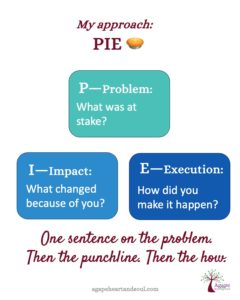
📌 I came up with PIE 🥧 because I find it easier to remember, and I like its story arc:
establish what was at stake, reveal what changed, then explain how
☀️ Problem: What problem were you addressing? You want your listener to understand what was at stake and get them invested in your story.
☀️ Impact: Give them the punchline. What impact did you achieve? What changed because of your contribution? Now they know what changed—and they’re ready to hear how you did it.
☀️ Execution: How did you make that happen? This is where you explain your decisions, the trade-offs, and how you brought people with you.
HERO or PIE: where does your story begin?
HERO leads with the outcome.
With PIE, you give the problem one sentence first–just enough to make the impact meaningful. Then you explain how you got there.
At senior level, the impact you made, the judgement behind your decisions, and how you brought others with you is what matters most. That’s why HERO or PIE appeal more to me.
Try it with an example from your career
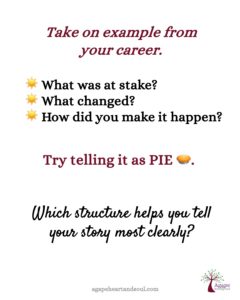
📌 Take one example from your career. Which structure helps you tell it most clearly?
Let me know in the comments 👇🏽.
With love,
Dina 🫶🏽
Previous related posts in the career-exploration series:
- When a good job is no longer the right job: why I resigned from my C&B role at Novartis
- How to explore a new career without quitting your job: the value of mini-experiments
- How I got a job at the UN—and discovered that my dream career wasn’t the right fit
- How career experiments helped me find my way back to HR
- A step back on paper. Seventeen years of possibilities
Previous related posts in the CV-writing series:
- CV tip: How to tailor your CV for a target role
- CV tip: How to write a CV that doesn’t sound like a job description
- CV tip: How long should your CV be?
- CV tip: Is your CV up to date, but still wishy washy?
- Career change strategy: Different moves need different approaches
Recent Comments