
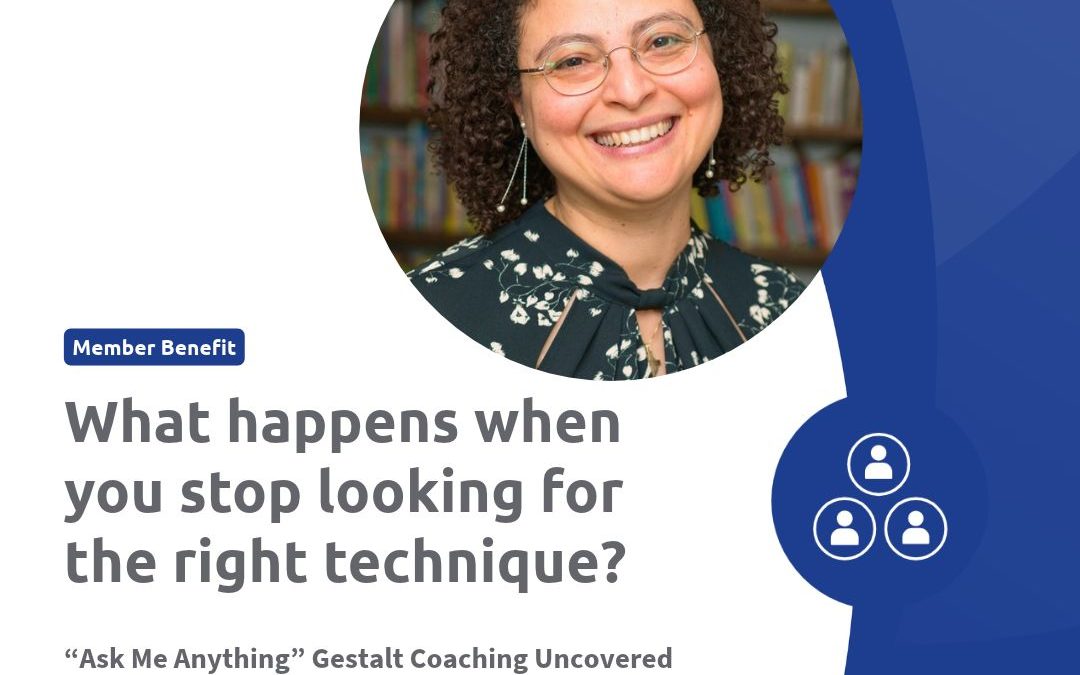
Gestalt coaching uncovered: Reflections on my Association for Coaching webinar
(Video excerpts below 👇🏽)
Some conversations leave you so energised that you just can’t wait to have more of them. 😊
That’s how I felt after leading “Ask Me Anything: Gestalt Coaching Uncovered” last week, hosted and facilitated by the Association for Coaching.
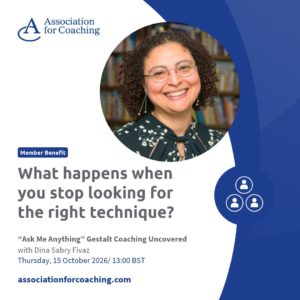
🎉 More than 140 coaches registered, and over 35 joined us live.
To everyone who took part: thank you for your generous presence, your insightful questions, and warm curiosity! 🫶🏽
And heartfelt thanks to Smaranda Dochia, Jane Webster and Lenka Klimova at the AC for hosting and facilitating this wonderful space.
My hope was that participants would feel something of the power and beauty of Gestalt Coaching—and leave curious about this way of experiencing ourselves, others, and the world. And given the feedback received after the session, I’d like to think “mission accomplished” ☀️.
What did we uncover?
The beauty of an “Ask me anything” format is that I arrive with no agenda and no slides—in true Gestalt spirit. This leaves room for what wants to emerge through the people in the room—the things they bring and that they’re genuinely curious about, in the present moment.
The questions took us through some of the foundations of Gestalt and into what it might look like in practice.
We explored:
- What Gestalt means and where it comes from.
- What makes it such an eclectic approach.
- Figure, Ground, and Field
- The cycle of experience, and how it gets interrupted
- Awareness, choice, and our ability to respond
And, of course, I shared my favourite Gestalt mantra:
Movement creates difference.
Difference creates awareness.
Awareness creates choice.
Choice strengthens our ability to take responsibility for our lives—or, as Perls liked to say, our response-ability.
There was much to talk about. The questions and curiosity in the room made this mutual exploration a real joy. I could honestly have done this for half a day, not just 60 minutes 🙈.
Gestalt challenges us
Some of the questions we also explored concerned the importance of defining and achieving goals in coaching, measuring progress, and whether Gestalt is “therapy”. You’ll find some of my answers to those questions in the video excerpts below.
Behind these questions lie two things, in my view:
- Our conscientiousness as coaches and our desire to be “good” coaches and act ethically.
- Introjections—rules we may have swallowed whole without truly digesting them and making them our own.
I believe that, as coaches, we owe it to ourselves and our clients to be critical thinkers and, why not, philosophers 😊.
In my view, the coaching profession is still in its infancy, which also means that it is being continuously shaped, defined, and transformed by new thinking and experiences.
So, my invitation to every coach out there is to question every coaching mantra and “sacred cow”—including the ones I offer you on this page. Make sure that whatever you decide to espouse as a value or belief in your coaching practice has been fully digested and adopted with conviction—not just out of compliance or reverence for the one saying it.
“It gave me the confidence to try some things”
All 13 respondents to the overall rating question rated the webinar “Excellent”.
To the question “What did you find particularly useful in this session?”, one participant wrote:
“I just loved all of it. Some practical examples about what Gestalt coaching looks like in practice and how one might incorporate it. Really refreshing and gave me the confidence to try some things”
That last part means a great deal to me: “gave me the confidence to try some things”.
My goal is for coaches to find the courage to show up in the room—show up in that coach-client relationship—as the unique and beautiful individuals they are: with their thoughts, feelings, sensations, and even opinions. No masks. No roles. A relationship imbued with the spirit of Martin Buber’s I-Thou, as much as possible, of course.
Another participant shared:
“The energy that Dina created and her heartfelt explanations. They came from deep within and were hence very authentic”
And someone else wrote:
“All of it to be honest – probably the best webinar I’ve been to (and not just for coaching). Brilliant speaker, full of honesty, passion and willingness to share – properly engaging”
Gestalt means a lot to me. It’s transformed how I show up in the world and in my coaching work. And so, to hear that this passion may have come through and encourage others to find out more about Gestalt means the world to me.
And I admit that the occasional smiles and nodding faces were also a very welcome reassurance to the introvert in me.
What I’m taking into what comes next
The feedback also offered useful suggestions: some introductory reading to help participants arrive with a shared foundation, and making sure an individual question doesn’t become an extended one-to-one supervision conversation.
I appreciate that feedback very much. And in fact, I will already be able to apply it to my guest lecture that I plan to deliver next month on the University of Cambridge’s Certificate in Coaching programme.
And there was also clearly an appetite for more 😊:
“This session could have been two hours and I still would not have tired of it”
“I could have quite happily listened to Dina speak and answer questions for a whole afternoon”
I honestly felt the same way… When I left the call, I was on cloud nine, and that buzz stayed with me for the rest of the week.
Coming in 2027: Gestalt Coaching Practice Labs
My 2027 Gestalt Coaching Practice Labs and new introductory Gestalt videos are taking shape.
The wish to understand what Gestalt looks like in practice— and to feel confident enough to explore it—connects closely with what I want to offer through the labs: space to bring your curiosity, explore Gestalt ideas, experiment and reflect on how they inform your own way of coaching.
I’m also planning a Gestalt webinar series with the Association for Coaching in spring 2027. More opportunities to ask questions and explore together.
And I have a few more Gestalt-related projects up my sleeve… let’s see if they materialise 😊.
Curious to hear more?
🌱 If you’d like to be among the first to hear about my 2027 Gestalt Coaching Practice Labs, do join my CURIOUS list.
I’ll share more as the plans become ready.
Thank you again to everyone who joined the webinar, brought a question or took the time to share feedback. You’ve given me plenty to celebrate—and plenty to carry into what comes next.
With love,
Dina 🫶🏽
Watch four excerpts from the webinar:
1. Why I love Gestalt so much
2. What about goals in Gestalt & my personal Gestalt mantra
3. How do I know that I’m making progress as a Gestalt coach?
4. Experiments in Gestalt Coaching: an act of bravery and love (agape)







Recent Comments