
Not all career changes are equally difficult.
And not every career move needs the same strategy.
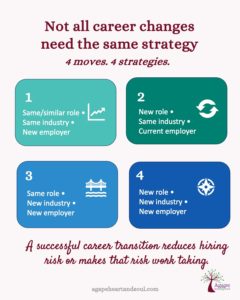
There’s a difference between moving to:
1️⃣ Same/similar job, same industry, new employer
2️⃣ New job, same industry, current employer
3️⃣ Same job, new industry, new employer
4️⃣ New job, new industry, new employer
The bigger the career change, the harder you need to work to create a bridge between what you’ve done and where you want to go. And the more a genuine human connection can matter.
☘️ Here’s how I think about it:
1️⃣ Same/similar job, same industry, new employer
Usually the most straightforward move.
- You have relevant experience,
- Speak the industry’s language, and
- Have a proven track record.
Your challenge is positioning: targeting the right employers and roles, showing relevant achievements, and making your value easy to see.
2️⃣ New job, same industry, current employer
Often the most accessible lateral move.
- You know the company, its stakeholders, and its language.
- People know you, can recommend you, and can help you understand what the hiring manager needs.
- You’re already inside the company, making it easier to network, reach out to decision-makers, do an internal rotation, and open doors.
3️⃣ Same job, new industry, new employer
The difficulty depends on how transferable your role is.
- In IT, HR or Finance, core skills may travel more easily (see Category 1)—you still need to explain your motivation for the new industry.
- Technical and scientific roles may prove to be trickier (see Category 4).
4️⃣ New job, new industry, new employer
This is the most demanding move, because you’re asking someone to take a chance on you without direct experience in either the role or the sector.
This is where your strategy needs to be deliberate, and where creating a genuine human connection matters most:
- Run mini-experiments to test the direction, gain evidence, and widen your network within the new industry.
- Build missing competencies through a course, project or further education.
- Find ways to be seen in action: short-term or pro bono mandates, events, conferences, LinkedIn.
- Write a motivation letter, even if it’s not required. Make it personal and specific.
- Send spontaneous applications—an underrated strategy but effective in Switzerland.
- Humanise your CV. Include a relevant thread from your background, career decisions or meaningful interests. In DACH markets, you may also consider a professional photo.
- Make a Category 1 move first, then a 2.
👉🏽 So, if you’re looking for your next step:
- Identify the move you’re making
- Build the evidence, relationships, and story that match it.
A successful career transition either reduces the risk someone feels when they consider hiring you OR makes that risk worth taking.
📌 Which of these four moves are you considering right now?
📌 What successes or difficulties are you facing?
With love,
Dina 🫶🏽
Recent Comments